Window & Door Leaks in NZ: Causes, Warning Signs, Repairs and Costs
Window leaks and water entering around external doors can be difficult to diagnose. Moisture may appear along the bottom of a window frame, stain the surrounding plasterboard, damage a timber sill or collect on the floor near a ranch slider. The obvious assumption is often that the window or door itself has failed.
However, water may be entering through defective flashings, poorly sealed joinery, damaged cladding junctions, blocked drainage channels or a problem somewhere higher on the building’s exterior. In some situations, the moisture is condensation rather than rainwater penetration.
The most important decision is whether the problem involves the joinery itself, the surrounding building envelope or internal moisture conditions. Each requires a different investigation and repair approach.
This guide explains the common causes of window and door leaks in New Zealand homes, warning signs, safe investigations, repair and replacement options, indicative costs, building-consent requirements and when specialist weathertightness advice may be necessary.
Safety first: If water is reaching electrical fittings, significant damage is occurring, structural deterioration is suspected or an external door or window has become unstable, keep people away from the affected area and seek appropriate professional assistance. Do not disturb potentially damaged wall linings, undertake unsafe ladder work or attempt repairs from elevated exterior positions. If anyone is in immediate danger, call 111.
1. Understanding the Problem
External windows and doors form part of a building’s weatherproofing system. They must allow natural light, ventilation and access while preventing unacceptable water penetration into the surrounding structure.
This is more complicated than simply fitting a window into an opening.
A typical installation may involve the joinery frame, glazing, gaskets, seals, head flashings, sill details, jamb junctions, cladding, building underlay, air seals and other components.
These elements must work together to manage rainwater and prevent moisture from reaching vulnerable building materials.
How window and door weatherproofing works
Depending on the construction method, an external window or door installation may be designed to resist water at the outer surface while also providing drainage paths for incidental moisture.
Some joinery frames have drainage channels and openings intended to discharge water to the exterior.
Similarly, certain wall assemblies incorporate cavities and flashings designed to manage moisture that passes behind the outer cladding.
These details are not interchangeable between all joinery types or cladding systems.
For example, an aluminium window installed in a drained-cavity wall can have different junction requirements from a timber window installed in an older direct-fixed weatherboard wall.
Understanding the construction is essential before choosing a repair.
Why the location of a leak can be misleading
Water does not always appear where it first enters.
Rainwater can penetrate a cladding junction above a window, travel down concealed framing and emerge at the internal sill.
Alternatively, water entering through a poorly weatherproofed door threshold may collect beneath floor coverings before any visible stain develops.
A damp windowsill is therefore evidence of moisture, but not necessarily proof that the window frame is defective.
Different window and door types
New Zealand homes contain a wide range of joinery, including:
- Aluminium-framed windows and sliding doors.
- Timber casement, sash and awning windows.
- uPVC joinery.
- French doors, hinged entrance doors and bifold systems.
- Ranch sliders and other large glazed door assemblies.
- Bay windows, corner windows and complex architectural glazing.
Each has distinct drainage, sealing, hardware and installation details.
A repair suitable for an older timber sash window may not be appropriate for a contemporary aluminium or uPVC unit.
Why these leaks matter
Persistent water entry can affect plasterboard, skirtings, flooring, insulation and timber framing.
The extent of the problem depends on how much moisture enters, how frequently the leak occurs and whether concealed materials can dry.
A relatively small visible stain may indicate localised damage—or a more serious concealed weathertightness problem.
The aim is to determine which situation exists before committing to repairs.
2. Recognising the Signs and Symptoms
Some window leaks become obvious during heavy rain. Others develop gradually, with damage appearing long after the original water entry.
Water appearing on internal windowsills
Water pooling along an internal sill may indicate a leak through the joinery, a blocked drainage detail or rainwater entering around the installation.
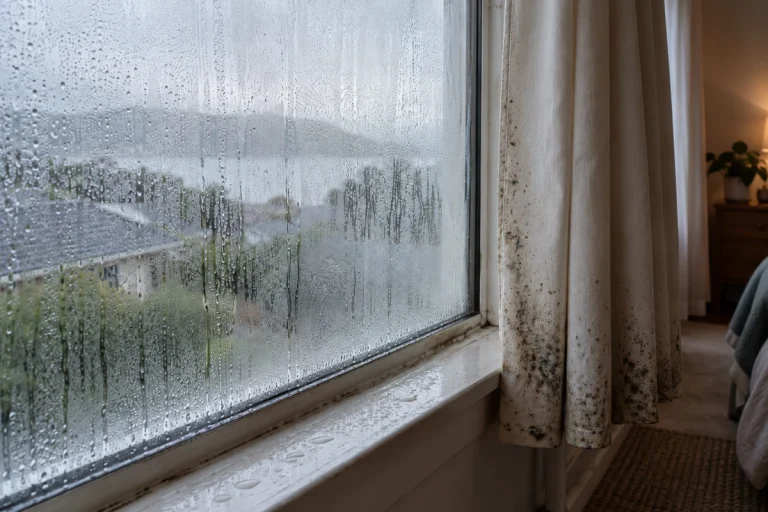
However, condensation collecting on cold glass can produce similar symptoms.
The conditions under which the water appears are important.
Staining around window or door reveals
Discolouration of the plasterboard or timber surrounding a window may indicate repeated moisture exposure.
Particular attention should be paid to stains at the upper corners, lower corners or along the junction between the joinery and surrounding wall.
These positions can provide clues about how water is travelling.
Swollen or damaged skirtings
Moisture entering around doors can travel beneath flooring and affect skirtings or architraves.
Swelling, bubbling paint, distortion and softening of timber may indicate that the problem has been occurring for some time.
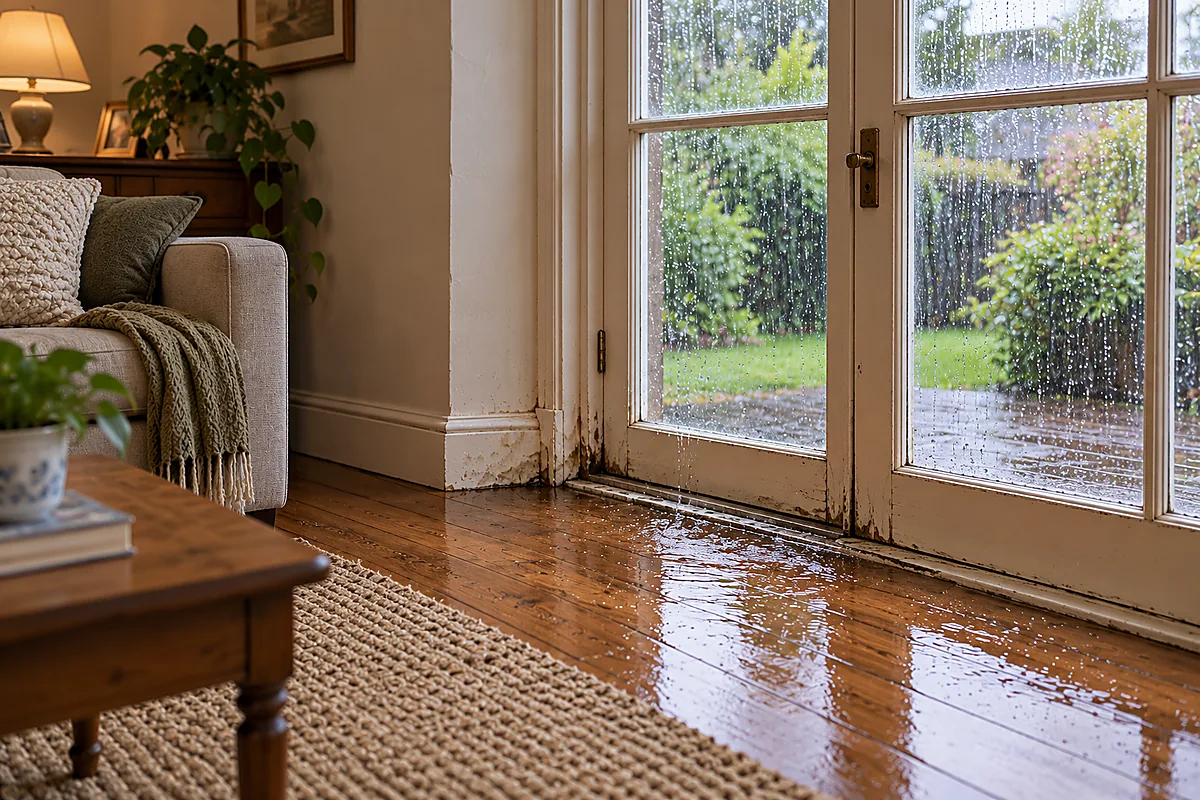
Damp carpet or flooring near a sliding door
Water collecting near a ranch slider or external doorway may originate from the threshold, surrounding cladding, adjacent paving or external drainage.
Where water is reaching flooring repeatedly, investigation should consider whether concealed floor materials have also been affected.
Soft or deteriorating timber
Timber window frames, reveals and surrounding framing can deteriorate when exposed to persistent moisture.
Visible softening or decay is a reason to investigate the extent of the damage rather than merely repainting the surface.
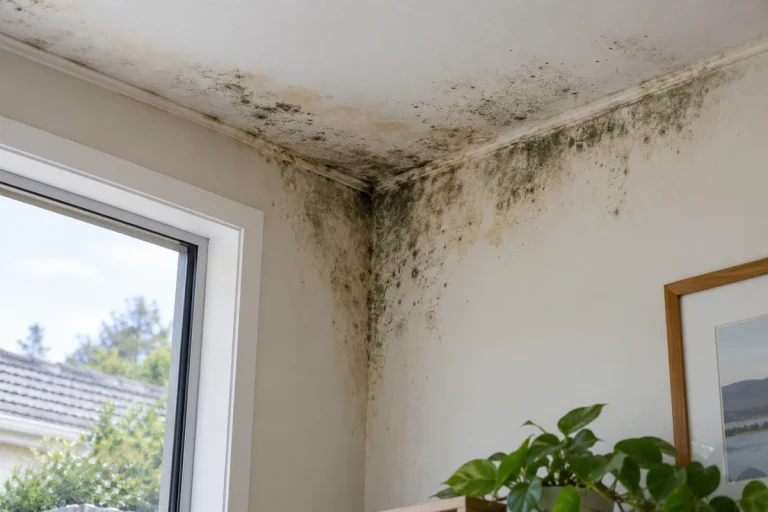
Mould and musty odours
Mould around windows can result from condensation, rainwater penetration or a combination of factors.
The presence of mould alone does not establish that a window leaks.
Persistent musty smells, swollen linings and recurring damp patches may warrant investigation of concealed moisture.
Condensation or water penetration?
This is one of the most important distinctions homeowners need to make.
| What you notice | Possible explanation |
|---|---|
| Water appears during wind-driven rain | Defective joinery seals, flashings or cladding junctions |
| Water collects on the inside of glass on cold mornings | Surface condensation |
| Fogging or moisture remains trapped between double-glazed panes | Possible failure of the insulated glazing unit’s edge seal |
| Water appears below a sliding-door track during heavy rain | Threshold drainage, door sealing or surrounding junction defect |
| Staining occurs above a window | Possible head flashing, cladding or higher-level water-entry issue |
| Internal reveals become damp after several hours of rain | Potential concealed water travel through the wall assembly |
| Water appears near a door when outside paving floods | Surface-water drainage, threshold height or exterior level problem |
| Mould forms repeatedly around cold window frames | Condensation or another persistent moisture source |
These observations help determine what to investigate first. They are not definitive diagnoses.
When symptoms suggest a wider problem
A single worn door seal may create a relatively straightforward maintenance issue.
However, leaks affecting several windows, recurring staining after repairs or evidence of deterioration within surrounding walls may indicate a broader weathertightness problem.
Such cases deserve a more systematic assessment.
3. Understanding the Possible Causes
Window and door leaks can originate from the joinery unit, the surrounding wall construction or external conditions.
The following causes should be considered separately because they lead to different solutions.
Deteriorated gaskets and weather seals
Many windows and doors use rubber, synthetic or other sealing components to help resist water and air penetration.
Over time, some materials may harden, shrink, split or become displaced.
Worn seals around opening sashes or doors can allow water to enter during certain weather conditions.
However, not every visible seal or bead is intended to provide the primary weathertightness barrier.
Replacing a gasket may resolve a genuine sealing defect, but it will not correct an incorrectly installed head flashing or failed cladding junction.
Blocked drainage channels and weep holes
Some aluminium and uPVC joinery systems are designed to collect limited amounts of incidental water and discharge it through drainage openings.
Dirt, paint, insects and other debris may obstruct these paths.
When drainage is compromised, water may accumulate in the frame or track and overflow towards the interior.
Any cleaning or maintenance should follow the joinery manufacturer’s instructions.
Do not seal drainage openings in an attempt to stop a leak. Doing so may interfere with the system’s intended function.
Defective head flashings
Head flashings help direct water away from the area immediately above a window or external door.
Problems may arise where flashings are missing, incorrectly installed, damaged or incompatible with the surrounding cladding.
Depending on the construction, water may pass behind the cladding and enter around the top of the joinery.
A sealant bead applied to the visible joint may not correct this type of defect.
Inadequate sill and jamb details
The sill is the lower part of a window opening, while the jambs form its sides.
These areas require appropriate junction details to manage rainwater.
Water may enter where sill protection is inadequate, junctions are poorly formed or components have deteriorated.
The correct details depend on the joinery and cladding system.
Replacing one visible seal without addressing the sill arrangement may leave a concealed problem unresolved.
Poorly installed or altered joinery
A window may leak because the installation does not suit the surrounding wall construction or exposure conditions.
Potential issues include unsuitable flashing details, incorrect clearances, inadequate support, poor integration with building underlay or changes made during previous renovations.
A replacement window should not simply be fitted into an old opening without considering how its weatherproofing will work with the existing building.
Failed timber joinery
Older timber windows can develop decay, movement, open joints, failed putty or deteriorated coatings.
Some can be repaired effectively through targeted joinery work.
Others may have extensive deterioration that makes replacement more appropriate.
The condition of the surrounding wall framing should be distinguished from the condition of the window itself.
Sliding-door and threshold defects
External doors are vulnerable because they must accommodate regular movement and provide access between inside and outside.
A sliding door may develop problems with seals, rollers, alignment, tracks or drainage details.
Hinged doors may be affected by warped components, worn weatherstrips or unsuitable thresholds.
Where external paving or decking is too high, water may also reach vulnerable junctions.
The appropriate remedy may involve the door installation, external drainage, surrounding construction or several of these together.
Defective surrounding cladding
A leak appearing near a window may originate from the wall rather than the joinery.
Cracked cladding, defective coating systems, poorly detailed penetrations or unsuitable flashing arrangements can allow moisture into the building envelope.
Water may then travel behind the wall finish and appear around the nearest window opening.
This is one reason repeated window resealing sometimes fails.
If moisture appears to be entering from a roof junction above the affected window, our Roof Leaks NZ guide explains common roofing defects, warning signs and appropriate investigation methods.
Building exposure and wind-driven rain
Homes on exposed coastal sites, elevated sections or locations experiencing strong prevailing winds may be subject to demanding weather conditions.
Wind-driven rain can reach junctions that remain dry during ordinary vertical rainfall.
The relevant wind exposure and building design should be considered when assessing weatherproofing performance.
Condensation mistaken for leakage
Warm, humid indoor air can deposit moisture on cold glass and frames.
Condensation may collect on the sill, damage paintwork or encourage mould growth.
It may be particularly noticeable on winter mornings, even when no rain has fallen.
Moisture trapped between the panes of an insulated glazing unit is a separate issue involving the glazing unit’s sealed construction.
Neither condition automatically indicates that rainwater is entering through the building envelope.
Correct diagnosis depends on distinguishing the moisture source, the entry mechanism and the extent of any resulting damage.
4. Assessing Seriousness and Urgency
Not every window leak is an emergency, but persistent water entry should not be ignored.
Situations requiring urgent attention
Obtain appropriate professional help promptly where:
- Water is affecting electrical outlets, switches or nearby installations.
- An external door or window is unstable or at risk of detachment.
- Significant amounts of water are entering during severe weather.
- Framing, flooring or other building components appear seriously deteriorated.
- Broken glazing creates an immediate injury hazard.
- Water is entering near an occupied area where structural instability is suspected.
Keep people clear of dangerous areas and do not handle electrical equipment that may be wet.
If anyone is in immediate danger, call 111.
When the problem may be less urgent
Minor condensation on a cold window is generally different from an active rainwater leak affecting concealed framing.
A small amount of water associated with a clearly identified, accessible maintenance issue may permit a planned repair.
However, recurring moisture, staining or deteriorating materials should be assessed before the problem progresses.
Why recurring leaks deserve particular attention
Repeated wetting and drying can damage building materials over time.
A window may appear to leak only during strong winds, while concealed moisture remains for much longer.
If earlier repairs have failed, the diagnosis should be reconsidered rather than automatically repeating the same treatment.
Temporary measures
Reasonable temporary protection may reduce further damage while specialist assistance is arranged.
However, homeowners should not block drainage openings, undertake unsafe exterior work or conceal the problem with surface sealants.
A temporary repair should be clearly distinguished from a permanent remedy.
5. What the Homeowner Should Investigate
Homeowners can gather useful information without dismantling joinery or opening wall linings.
The safest approach is observation, documentation and reviewing the history of the problem.
Identify when the moisture appears
Record whether water enters during:
- Heavy rainfall.
- Wind-driven rain.
- Prolonged wet weather.
- Cold mornings without rainfall.
- Use of an adjoining bathroom or plumbing fixture.
- Periods of heavy surface-water runoff.
This information may help distinguish external penetration from condensation or another source.
Photograph the affected area
Take photographs of water, stains, swollen finishes, damaged joinery and surrounding construction.
Record the date and relevant weather conditions.
If the leak is intermittent, this documentation can help the professional understand what occurs when the problem is active.
Check the location of moisture
Observe whether moisture appears:
- On the glass itself.
- Between double-glazed panes.
- Along the internal sill.
- At the top corners of the reveal.
- Below the frame.
- Along the door threshold.
- On adjacent plasterboard, flooring or skirtings.
These patterns can help narrow the investigation.
Observe accessible drainage details
Where the joinery manufacturer permits routine homeowner cleaning, inspect accessible tracks and drainage areas for obvious debris.
Use appropriate, non-damaging cleaning methods.
Do not drill new holes, remove concealed seals or block openings without professional advice.
Review previous work
Consider whether the problem began after:
- Window or door replacement.
- Cladding repairs or repainting.
- Deck or paving alterations.
- Installation of awnings, pergolas or other attachments.
- A severe storm or impact event.
A change immediately before symptoms appeared may be relevant, but its involvement must still be established.
Consider the building’s age and construction
A timber villa, a 1970s weatherboard home, a plaster-clad townhouse and a modern cavity-clad dwelling may require different investigation methods.
In homes with potential weathertightness concerns, the installation details and surrounding wall construction can be as important as the joinery itself.
What homeowners should avoid
Do not remove flashings, cut into exterior cladding or open internal wall linings simply to find a leak.
Avoid using a pressure washer or uncontrolled hose test to force water into suspected junctions.
Professional water testing should be carefully planned to avoid creating damage or misleading results.
For buildings constructed or renovated before 2000, be aware that some cladding, backing materials and other building products may contain asbestos.
Do not disturb suspect materials without appropriate assessment.
The homeowner’s role is to gather evidence safely, not to undertake invasive testing.
6. Available Solutions and Repair Pathways
The appropriate solution depends on whether the defect involves routine joinery maintenance, a failed component, an installation problem or a wider building-envelope issue.
Option 1 — Drainage and maintenance work
Where investigation establishes that an otherwise sound window has blocked drainage channels or minor maintenance problems, appropriate cleaning or servicing may resolve the issue.
This is generally less disruptive than replacing the joinery.
However, maintenance is not a substitute for correcting a defective flashing or water-damaged wall assembly.
Option 2 — Replacement of suitable seals or gaskets
Where weather seals have deteriorated and are confirmed as the cause, compatible replacement components may restore the intended performance.
The work should account for the joinery system, age and manufacturer specifications.
Do not assume that generic sealant applied around the outside of a frame will reproduce the original designed weatherproofing.
Option 3 — Joinery adjustment and hardware repair
Opening sashes and doors can lose alignment because of wear, movement or damaged hardware.
A specialist may be able to adjust the joinery, repair hardware or restore proper closing pressure.
This can be suitable where the frame and surrounding building elements remain sound.
Option 4 — Targeted timber joinery repair
Some timber windows can be repaired by competent joinery specialists.
The scope may include repairing damaged timber, restoring suitable coatings or replacing deteriorated components.
Where decay is extensive, a localised repair may not be durable.
Any concealed damage around the window opening must also be considered.
Option 5 — Flashing and junction remediation
Where water enters through an incorrectly installed head, sill or jamb detail, the repair may require removing surrounding components and reconstructing the junction.
This work is fundamentally different from applying sealant to the visible edge.
The repair should follow a suitable weatherproofing detail for the actual wall and joinery system.
Option 6 — Window or door replacement
Complete joinery replacement may be appropriate where the existing unit has substantial deterioration, repeated functional failures or defects that cannot be economically repaired.
However, the decision must account for the surrounding construction.
A new window fitted into a defective opening can reproduce the original leak if the underlying cause is not corrected.
Replacing joinery may also trigger Building Code requirements and, in some circumstances, building consent.
Option 7 — Wider weathertightness remediation
Where investigation identifies concealed moisture damage, repeated failures across multiple openings or defective cladding integration, a broader repair may be required.
This can involve redesigning junctions, replacing affected cladding, removing damaged framing or undertaking other building-envelope work.
Such projects may require an experienced building surveyor, designer, Licensed Building Practitioner and potentially a structural engineer.
The objective is to correct the complete water-entry mechanism rather than one visible symptom.
Option 8 — Condensation management
Where the moisture is primarily caused by internal condensation, replacing flashings or resealing the exterior may achieve nothing.
An appropriate response may involve improving indoor moisture extraction, heating, insulation, ventilation or window thermal performance.
The best measures depend on the home’s actual conditions.
Persistent moisture should be assessed carefully before large expenditure is committed.
Repairing associated internal damage
Once water entry has been stopped, affected plasterboard, insulation, skirtings, flooring and concealed framing should be assessed.
Some finishes can be repaired after they are adequately dry and confirmed to remain sound.
Materials that have deteriorated or lost integrity may require replacement.
Repainting alone does not address concealed water damage.
7. Costs and Financial Considerations
The cost of resolving a window or door leak depends heavily on the actual cause.
A straightforward seal replacement is financially very different from removing a window, reconstructing its flashings and repairing water-damaged framing.
It is therefore misleading to treat all window leaks as one standard repair job.
Indicative New Zealand cost considerations
Published 2026 Auckland joinery-service information suggests some professional window-seal replacements may cost approximately $300–$800 per window, depending on the unit and scope.
This is a contractor-published Auckland guide, not an independently established nationwide rate or a quotation for your home.
The amount should not be used as an estimate for concealed weathertightness repairs.
| Type of work | Main cost considerations |
|---|---|
| Inspection or initial fault diagnosis | Time, access, specialist expertise and written reporting |
| Drainage cleaning or hardware servicing | Joinery type, accessibility and replacement components |
| Gasket or weather-seal replacement | Compatibility, number of windows, dismantling and labour |
| Timber joinery repair | Extent of decay, specialist workmanship and finishing |
| Flashing or sill remediation | Removal of joinery or cladding, detailing and reinstatement |
| Complete window or door replacement | Size, glazing, material, manufacturing, access and installation |
| Concealed weathertightness repair | Investigation, framing damage, cladding, design and consent |
| Interior reinstatement | Drying, plasterboard, skirtings, flooring and painting |
For a current pricing reference, see this 2026 Auckland window-seal replacement cost guide.
Why a simple repair estimate can be misleading
A contractor may quote to replace an external seal without knowing whether the surrounding wall is damaged.
If the actual leak originates from a concealed flashing defect, the visible seal repair may provide little benefit.
Similarly, replacing an entire window when only an accessible drainage issue exists may result in unnecessary expense.
A sound financial decision begins with adequate diagnosis.
Investigation costs versus repair costs
Where the source is uncertain, some investigation expenditure may be justified before a substantial repair is authorised.
This can be especially important for recurring leaks or homes with possible concealed moisture damage.
A written professional assessment may identify several separate issues and help establish the appropriate scope.
The cost of investigation should be viewed alongside the potential cost of undertaking the wrong work.
Allow for concealed damage
Opening an affected wall can reveal deterioration that was not apparent during the initial inspection.
Quotations should explain what is included, what remains uncertain and how additional work will be assessed and authorised.
For larger remediation projects, a suitable contingency may be necessary.
Consider repair versus replacement
A relatively inexpensive repair can be good value when the joinery remains sound and the defect is isolated.
Full replacement may become more attractive where the unit has widespread deterioration, repeated hardware failures or poor remaining service life.
However, a new window is not a substitute for repairing damaged cladding or framing.
Insurance considerations
House insurance generally distinguishes between certain sudden accidental events and gradual deterioration, although individual policy provisions vary.
For example, damage following a severe storm may be treated differently from long-standing moisture penetration caused by deteriorated seals or construction defects.
Review the policy terms, document the damage and contact the insurer promptly where a claim may arise.
Do not assume all water damage is covered.
The value of written records
Professional reports, quotations, photographs, invoices, warranties and consent documentation help establish what work has been undertaken.
These records can be important if the leak recurs, an insurance question arises or the property is sold.
8. Legal, Regulatory and Consent Requirements
Work involving windows and external doors can be subject to different regulatory requirements depending on the building, the age and condition of the joinery, and the proposed repair.
New Zealand’s Building Act and Building Code should be considered before significant remediation begins.
Building Code Clause E2 — External Moisture
Clause E2 — External Moisture addresses the building’s performance in resisting unacceptable external moisture penetration and accumulation.
It is particularly relevant to external joinery, flashings, cladding junctions and associated weatherproofing components.
The requirements apply to the relevant building work, including work that may be exempt from obtaining building consent.
E2/AS1 and window-installation details
MBIE’s E2/AS1 guidance provides an Acceptable Solution pathway for qualifying building work within its scope.
The current framework addresses common cladding, flashing and opening details, including windows and doors.
Not every building or proposed detail falls within E2/AS1. Some work requires specific design or another means of demonstrating compliance.
A replacement installation should therefore be assessed against the actual cladding and building configuration.
Building Code Clause B2 — Durability
Clause B2 — Durability is relevant when assessing how long building elements must continue to meet their applicable performance requirements.
Durability is particularly important when determining whether a failed window or door qualifies for a building-consent exemption.
Does replacing a leaking window require building consent?
Not always. However, the exemption has important conditions.
Schedule 1, clause 8 of the Building Act 2004 provides an exemption for certain work involving windows and external doorways in existing dwellings and outbuildings of no more than two storeys.
The exemption does not apply to a replacement window or doorway that failed to satisfy applicable Building Code durability requirements. Nor does it cover work that modifies or affects a specified system.
MBIE explains that most external windows and doors have a minimum applicable durability period of 15 years.
Its guidance gives the example of replacing an older window that has reached that durability period as work that may qualify for the exemption.
By contrast, replacing a window that has failed prematurely because of a relevant durability or weathertightness defect can require building consent.
Importantly, this is not simply a question of the window’s age. The reason for replacement, the actual condition of the building and the scope of work must be assessed.
Read MBIE’s official guidance on windows and exterior doorways in existing dwellings.
What if surrounding cladding or framing is damaged?
Replacing joinery may be only one part of the required work.
Where repairs involve structural framing, extensive cladding remediation or other alterations, additional consent and design considerations may arise.
A window-replacement exemption should not be assumed to cover every associated building-envelope repair.
For substantial work, obtain advice from an appropriately qualified professional and confirm the requirements with the relevant council.
Restricted Building Work
Some residential building work involving primary structure or weathertightness is classified as Restricted Building Work.
Where that classification applies, the relevant work generally must be carried out or supervised by an appropriately Licensed Building Practitioner, subject to statutory provisions and exemptions.
However, not every window adjustment, seal replacement or consent-exempt installation is Restricted Building Work.
MBIE provides guidance on Restricted Building Work.
Other Building Code requirements
Depending on the proposed work, additional provisions may be relevant.
These can include structural performance, safety glazing, protection from falling, energy efficiency, ventilation or fire-safety requirements.
A window installation that is exempt from building consent must still satisfy applicable Building Code requirements.
Asbestos and older building materials
Work around windows in older homes may disturb existing cladding, backing boards or other materials.
WorkSafe advises that buildings constructed or renovated before 2000 may contain asbestos-containing products.
Suspect materials should be assessed before intrusive work.
See WorkSafe’s asbestos information for New Zealand homeowners.
Residential building contracts
For residential building work costing $30,000 or more including GST, a written building contract is mandatory.
Contractors must provide the prescribed consumer-protection checklist and disclosure statement where the threshold applies, or where the homeowner requests them.
Written agreements are also advisable for smaller jobs, particularly if the scope is uncertain.
See MBIE’s guidance on contracts for building projects.
Existing weathertightness defects and legal options
If the property may have a wider weathertightness defect, establish the facts before assuming who is responsible.
Depending on the property’s history and circumstances, legal advice may be appropriate.
MBIE confirms that the deadline for new claims under the former Weathertight Homes Resolution Services scheme expired on 31 December 2021.
That does not mean homeowners should assume they have no possible rights or remedies. Any available option depends on the specific facts and applicable law.
See MBIE’s information on weathertightness issues.
9. Which Professionals May Be Required?
The right professional depends on whether the problem originates within the window or door unit, its installation, the surrounding cladding or another moisture source. A joinery specialist or glazier may be appropriate for a clearly identified component defect, while recurring leaks, concealed damage or uncertain water entry may require an independent building surveyor or weathertightness specialist. The professional needed to establish the cause may differ from those subsequently required to design or complete repairs.
Window and door joinery specialist
A joinery specialist may be suitable where the problem involves drainage channels, operating hardware, damaged gaskets or deterioration of the joinery unit itself.
Confirm experience with the particular window or door system.
Glazier
A glazier may be required where the issue involves damaged glazing, glass installation or a failed insulated glazing unit.
Moisture trapped between double-glazed panes should not automatically be treated as an external wall leak.
Licensed Building Practitioner or experienced builder
A competent builder may be appropriate where repairs involve removing and reinstating joinery, flashings, cladding or surrounding construction.
Where the proposed work is Restricted Building Work, the relevant licensing requirements must be met.
Building surveyor or weathertightness specialist
An experienced building surveyor is particularly valuable where:
- Leaks repeatedly return after repairs.
- Water appears to originate from concealed junctions.
- Several windows or external doors are affected.
- There are signs of concealed framing deterioration.
- The property has known or suspected weathertightness defects.
- A substantial remediation project is being considered.
An independent assessment can help distinguish between minor joinery maintenance and broader building-envelope failure.
Building designer or architect
Complex flashing reconstruction, cladding remediation or changes to window openings may require competent design input.
The appropriate practitioner should understand the relevant building construction and compliance pathway.
Structural engineer
An engineer may be required where framing, lintels, bracing or other load-bearing elements are affected.
Not every leaking window requires engineering input.
The need should be based on the proposed work and condition of the structure.
Questions to ask before engaging a contractor
Ask what the proposed investigation is intended to establish and whether the source has been identified.
For repair proposals, ask whether the work includes surrounding flashings, concealed damage, reinstatement and any necessary approvals.
Where several trades are involved, establish who is responsible for coordinating the work and verifying the outcome.
The cheapest repair is not necessarily the best choice if it fails to address the actual water-entry mechanism.
10. Common Mistakes and Avoidable Risks
Assuming all water on a windowsill comes from rain
Condensation can resemble a leak.
Investigate the relationship between moisture, rainfall, indoor humidity and temperature before selecting a remedy.
Sealing over designed drainage openings
Some joinery systems rely on drainage channels and outlets.
Blocking these pathways can prevent water from escaping as intended.
Applying sealant without understanding the junction
Surface sealing can temporarily reduce visible water entry but may fail to correct defective flashings or cladding integration.
In some circumstances, indiscriminate sealing can interfere with the intended movement or drainage of moisture.
Replacing a window without examining the surrounding wall
A new joinery unit may not solve a problem caused by damaged wall framing or incorrect flashing details.
The complete installation should be considered.
Repainting damaged reveals too early
Painting over staining can conceal continuing moisture problems.
The source should be controlled and affected materials assessed before cosmetic reinstatement.
Ignoring recurring leaks
A leak that reappears after previous repairs warrants reconsideration of the diagnosis.
Repeating the same treatment without fresh evidence can increase cost and delay an effective solution.
Undertaking destructive DIY investigation
Removing flashings, wall linings or cladding without understanding the construction can create additional damage.
Older building materials may also present asbestos risks.
Assuming building consent is never required
The Building Act contains important exemptions, but they are conditional.
Premature failure and wider structural or weathertightness remediation can change the regulatory position.
Failing to document investigations and repairs
A clear record of the defect, professional advice and completed work can be valuable when assessing later problems or selling the property.
11. Making an Informed Decision
The best decision balances the evidence, the extent of damage, the suitability of repair options and the cost of getting the work wrong.
Scenario A — Water in an aluminium window track
Water collects in an aluminium window track during heavy rainfall.
A joinery specialist establishes that the unit’s designed drainage openings have become obstructed, while the surrounding installation is sound.
Appropriate maintenance may resolve the problem without replacing the window.
Scenario B — Water staining above a window
A stain appears above a bedroom window after wind-driven rain.
Investigation identifies an unsuitable head-flashing arrangement that allows water into the wall.
Replacing the window’s opening-sash gasket would not address the defect.
The repair should correct the flashing and assess any associated concealed damage.
Scenario C — Dampness beneath a ranch slider
Flooring becomes wet near an external sliding door during intense rainfall.
The surrounding paving sits high relative to the threshold, and external water collects against the doorway.
The remedy may require external drainage or threshold-related work, rather than simply replacing the sliding door.
The exact solution depends on investigation.
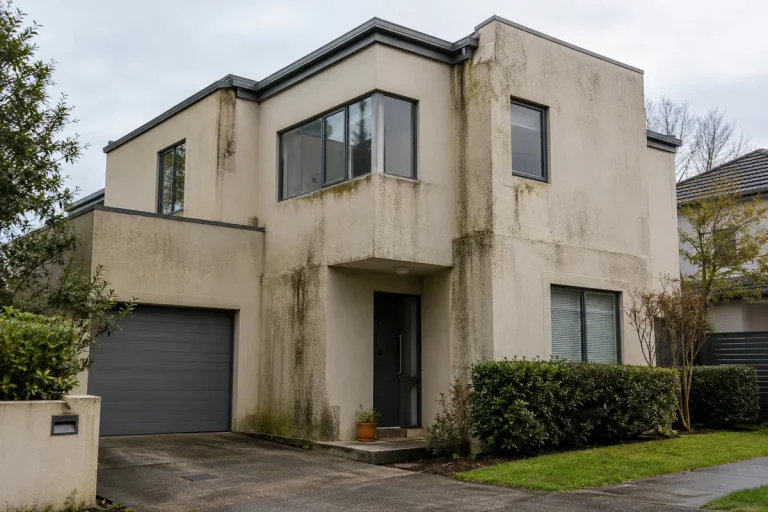
Scenario D — Several windows leaking in a plaster-clad home
A homeowner notices recurring staining around several windows, swollen skirtings and previous unsuccessful sealant repairs.
This pattern raises concern about possible wider weathertightness defects.
A suitably experienced independent building surveyor may provide better value than commissioning multiple isolated window repairs.
Scenario E — Condensation on bedroom windows
Water appears on internal glass during winter mornings but not specifically after rain.
The windows show no confirmed external water-entry defects.
The appropriate response may focus on indoor humidity, thermal performance and ventilation rather than external flashing repairs.
A practical decision framework
Before committing to major work, establish:
- Source: Is the moisture rainwater, condensation or another form of water entry?
- Location: Does the defect involve the joinery, the surrounding construction or both?
- Extent: Is the problem isolated or affecting multiple openings?
- Damage: Has concealed deterioration been reasonably assessed?
- Remedy: Will the proposed repair address the identified cause?
- Compliance: Are design, consent or practitioner requirements involved?
- Value: Is a targeted repair likely to be durable, or is more extensive replacement justified?
- Verification: How will the contractor demonstrate that the repair has worked?
If substantial uncertainty remains, further investigation may be preferable to authorising expensive remedial work.
12. Your Recommended Next Steps
Your Window & Door Leak Action Plan
Step 1 — Check for urgent safety concerns
Keep clear of unstable joinery, broken glazing, damaged electrical equipment and significantly deteriorated building components.
Seek urgent professional assistance where necessary.
Step 2 — Document the symptoms
Photograph the affected area and record when moisture appears.
Note whether the problem relates to rainfall, wind direction, temperature or indoor humidity.
Step 3 — Identify the likely moisture category
Consider whether water is collecting on the glass, entering through the joinery, travelling through surrounding wall construction or reaching the doorway from external surface water.
Treat this as an initial assessment, not a final diagnosis.
Step 4 — Gather information about the building
Record the joinery type if known, approximate age, previous repairs and any relevant alterations.
Photographs and building records may help the investigation.
Step 5 — Engage an appropriate professional
Choose a professional suited to the suspected source of the leak. A joinery specialist or glazier may be appropriate for an identifiable window or door component defect, while recurring leaks, concealed damage or uncertain water entry may require an experienced building surveyor or weathertightness specialist. Establish the likely cause and appropriate repair scope before commissioning substantial remedial work.
Step 6 — Obtain a clear repair proposal
Ask for an explanation of the identified cause, proposed work, inclusions, exclusions and whether associated damage will be investigated.
Confirm any required design, consent and licensing arrangements.
Step 7 — Complete the appropriate remediation
Ensure the work addresses the actual moisture-entry mechanism.
Repair or replace affected internal materials only after the source is controlled and the condition of the surrounding construction is understood.
Step 8 — Verify the outcome and retain records
Obtain suitable confirmation of the completed work and retain relevant photographs, reports, quotations, invoices, warranties and approval documents.
Final consideration
A leaking window or external door is not always a defective window or door.
The real problem may be a worn gasket, blocked drainage channel, poorly formed flashing, damaged wall cladding, unsuitable threshold arrangement or internal condensation.
Some situations can be resolved through straightforward maintenance. Others require specialised investigation and substantial weathertightness remediation.
The right approach is to identify where the moisture originates, understand how it reaches the affected area and select a durable repair that addresses the cause—not simply the visible symptom.