Roof Leaks in NZ: Causes, Warning Signs, Repairs and Costs
Roof leaks in NZ homes can begin with something as small as a damaged roof fixing or as complicated as a poorly designed roof junction. During heavy rain, even a relatively minor defect can allow water to enter the building, potentially damaging insulation, ceiling linings, timber framing and electrical installations.
The important question is not simply how to stop the visible leak. It is why the roof is allowing water through, whether the problem is isolated or widespread, and which repair will provide a durable solution.
This guide explains the main causes of roof leaks in New Zealand, how to recognise warning signs, what homeowners can investigate safely, the repair and replacement options available, likely costs, regulatory requirements and how to choose an appropriate roofing professional.
Safety first: Do not climb onto a roof to investigate an active leak, particularly during rain or strong winds. Keep clear of damaged roofing, hanging debris and any water affecting electrical equipment. If an internal ceiling is sagging or water is entering electrical fittings, move away from the affected area and seek urgent professional assistance. If anyone is in immediate danger, call 111.
1. Understanding the Problem
A roof is more than its visible outer covering. It is a system of roofing materials, flashings, fixings, drainage components, underlay, structural supports and carefully designed junctions.
These elements must work together to prevent rainwater from entering the building and to manage water that collects on its exterior surfaces.
A roof leak occurs when that system allows water to reach a location it should not. The defect may involve one damaged component or a combination of weaknesses.
For example, a roof can have perfectly serviceable metal sheets but still leak because a flashing around a chimney is incorrectly installed. Likewise, a relatively new roof may suffer repeated water entry if the roofing profile is unsuitable for its pitch or rainwater is not draining properly.
Why the roof’s construction matters
New Zealand homes commonly have long-run metal roofing, pressed-metal tiles, concrete or clay tiles, or membrane roofing systems.
Each has different installation details, expected maintenance requirements and potential failure points.
A steep, straightforward gable roof generally manages rainwater differently from a complex roof with multiple valleys, skylights, parapets and internal gutters.
The home’s location also matters. Coastal environments can accelerate corrosion. Exposed sites may experience strong wind-driven rain, while trees can contribute leaves and debris to gutters and valleys.
A roofing problem should therefore be assessed in the context of the building’s age, roof design, materials, exposure and maintenance history.
A roof leak may appear somewhere else
Water entering through a roof does not always become visible directly beneath the defect.
It may run along underlay, rafters, purlins, battens or other building components before reaching an internal ceiling or wall.
Consequently, an internal stain can be several metres away from the actual water-entry point.
If your main concern is an internal stain, dripping ceiling or suspected hidden water damage, our separate guide, Water Leaking Through Your Ceiling? What NZ Homeowners Should Do First, explains how to assess those symptoms and distinguish roofing defects from plumbing and condensation.
The present guide focuses on diagnosing and resolving defects in the roofing system.
2. Recognising the Signs and Symptoms
Some roof leaks become obvious during a storm. Others develop gradually and may remain concealed until significant staining or deterioration appears.
Common signs inside the home
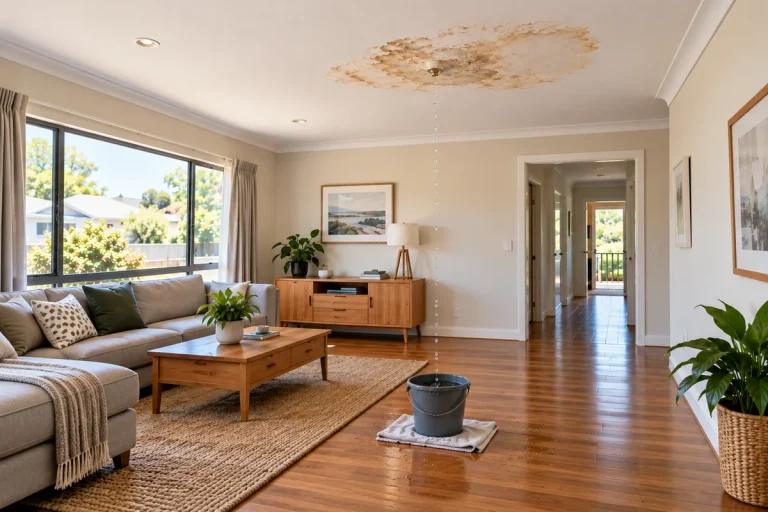
Ceiling stains after rainfall
Brown or yellow marks appearing or enlarging after rain can indicate water entering from the roof or an adjoining external building element.
Water around roof penetrations
Drips appearing near skylights, chimney locations, ventilation ducts or ceiling fittings may be associated with a roof penetration, although water can travel before becoming visible.
Dampness near the top of an external wall
Moisture at ceiling-to-wall junctions, near eaves or below roof-to-wall intersections can suggest a flashing, gutter or external weatherproofing problem.
Musty odours after wet weather
Persistent moisture in roof spaces may contribute to odours and mould growth. However, these symptoms can also arise from condensation and should not be treated as proof of a roof defect.
Repeated staining following previous repairs
If internal stains keep returning despite sealant application or patch repairs, the original entry point may not have been correctly identified.
Visible external warning signs
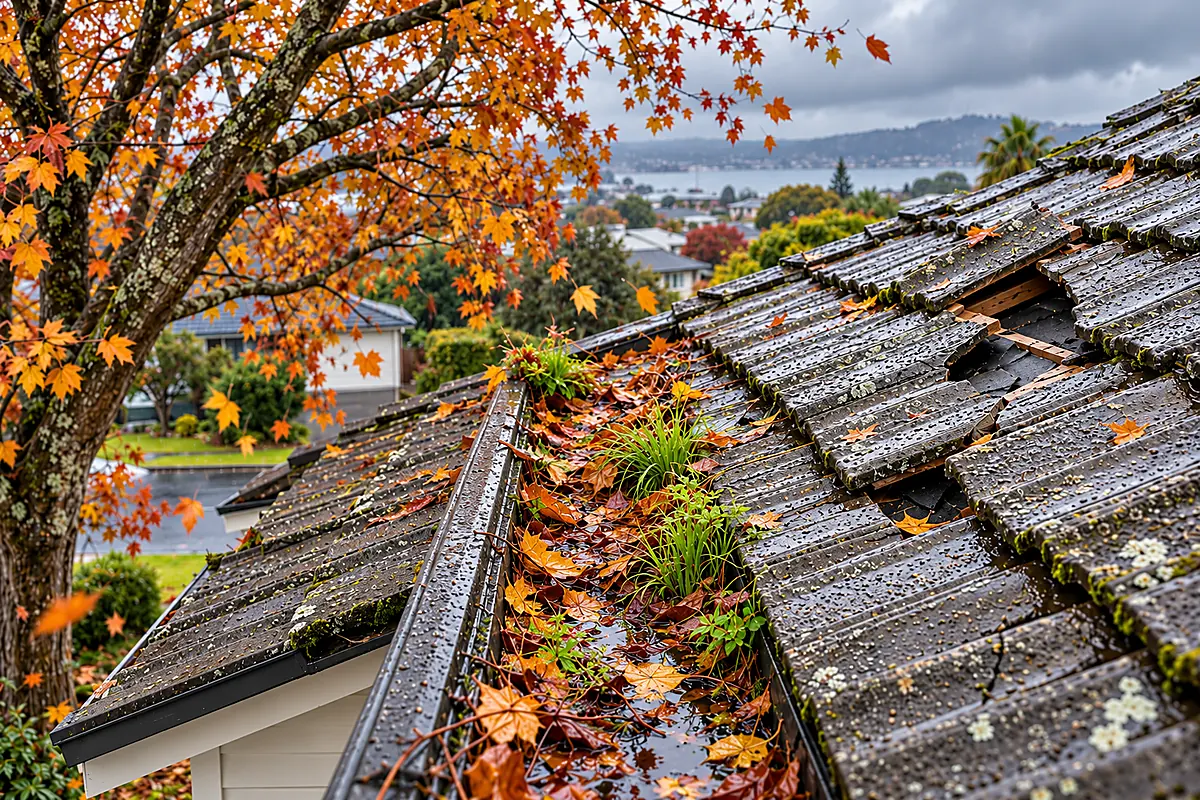
From a safe position on the ground, some homeowners may notice displaced tiles, lifted or damaged roofing sheets, debris-filled gutters, loose flashing edges, visible corrosion or damaged ridge details.
These are useful observations, but not every defect can be seen from outside.
What the pattern tells you
| What you notice | Possible explanation |
|---|---|
| Leaks mainly during wind-driven rain | Vulnerable flashing, roofing junction, lap or penetration |
| Water appears during prolonged rainfall | Saturated or poorly drained roof detail, concealed water path or overflowing drainage |
| Water enters after intense downpours | Gutter, valley, outlet or roof-drainage capacity problem |
| Leak follows a severe windstorm | Displaced tiles, lifted roofing, damaged flashings or impact damage |
| Rust staining or corrosion on roofing | Coating deterioration, incompatible materials, local environmental exposure or ageing |
| Leak persists after a small patch repair | Incorrect diagnosis, multiple defects or deterioration extending beyond the repaired location |
| Dampness occurs without rainfall | Condensation, plumbing or another non-roofing moisture source |
These patterns can narrow the investigation, but none establishes a diagnosis on its own.
Why a small leak should not be ignored
A minor stain may reflect a relatively simple defect, but repeated moisture can affect concealed materials and create progressively more expensive repairs.
The visible damage is not a reliable indicator of the condition of the underlying roof structure.
Early investigation is therefore important, particularly where leaks recur or the cause is unclear.
3. Understanding the Possible Causes
Roof leaks can arise from several different components. A competent investigation should consider the roofing material, flashings, penetrations, drainage and the way the roof has been designed and maintained.
Metal roofing defects
Long-run profiled metal roofing is widely used in New Zealand.
Potential problems include corrosion, damaged sheets, defective laps, loose or deteriorated fixings, poorly installed flashings and unsuitable details around penetrations.
Corrosion can develop more quickly where protective coatings have been damaged or where environmental conditions are demanding.
A small area of surface corrosion does not automatically mean the entire roof needs replacement. Equally, widespread perforation or deterioration cannot reliably be resolved by painting over the visible damage.
Repairs must consider the compatibility of replacement components, fixings and roofing materials.
Concrete and clay tile defects
Tiled roofs can develop problems through cracked, displaced or broken tiles, defective ridge or hip details, ageing flashings and deteriorated supporting components.
Wind, impact, movement and previous foot traffic can contribute to tile damage.
In some cases, replacing a small number of damaged tiles is sufficient. In others, the problem involves underlay, valleys, flashings or deterioration across a larger section.
A specialist should assess whether the roof remains serviceable rather than assuming that any cracked tile requires extensive reroofing.
Failed or unsuitable roof flashings
Flashings help direct water away from vulnerable junctions.
Common locations include roof-to-wall intersections, chimneys, skylights, roof edges, valleys, parapets, vents and other penetrations.
A flashing may fail because it has corroded, lifted, been damaged or was incorrectly detailed in the first place.
This distinction matters.
Replacing a deteriorated flashing can be a straightforward repair, while correcting an incorrectly designed junction may require more extensive work.
Repeated applications of sealant can conceal the underlying problem without providing a durable solution.
Blocked or defective roof drainage
Rainwater must be able to leave the roof safely.
Leaves, sediment, moss, accumulated debris and damaged gutter components can interfere with drainage.
Valleys, internal gutters, outlet connections and downpipes may be particularly important because they collect water from larger roof areas.
Where water backs up or overflows, it may reach roof junctions, fascia boards, wall cladding or other areas not designed to withstand that exposure.
A drainage problem should be investigated as a system. Clearing one outlet may not resolve an issue caused by inadequate falls, defective gutter geometry or unsuitable drainage capacity.
Low-pitch and membrane roofing
Membrane roofs depend on an appropriate waterproofing system, correctly formed falls, properly detailed outlets and sound junctions.
Potential failures include punctures, splits, deteriorated seams, defective terminations, outlet problems and damage associated with movement or ponding.
Some low-pitch roofs are particularly sensitive to installation quality because water may drain more slowly than on steeply pitched roofs.
An effective repair depends on the membrane type and condition.
A patching product suitable for one membrane may be unsuitable for another. The system’s manufacturer requirements and compatibility limitations should guide remedial work.
Skylights, vents and roof penetrations
Every opening through a roof creates a junction that must be carefully weatherproofed.
Skylights, plumbing vents, flues, ventilation ducts, solar installations and other services can introduce potential entry points.
A roof that began leaking shortly after installation of new equipment warrants investigation of the affected junctions.
However, the timing of a change is evidence to consider, not conclusive proof of defective workmanship.
Roof pitch and inappropriate materials
Roofing products have limits on where and how they may be used.
A roofing profile may perform well on a suitably pitched roof yet be unsuitable for a shallower installation.
Similarly, incorrect laps, fixing arrangements or junction details can undermine the performance of otherwise sound materials.
Where a recurring leak is linked to an underlying design problem, replacing an individual component may not achieve a durable outcome.
Professional design advice may be needed.
Storm damage and external impacts
Strong winds, falling branches, airborne debris and other sudden events can damage a previously sound roof.
The resulting defect may be easy to identify, such as a displaced roof sheet, or less obvious, such as damage to fixings or flashing details.
After a significant storm, do not enter damaged or potentially unstable areas to inspect the roof yourself.
Condensation mistaken for a roof leak
Moisture found beneath roofing does not always mean rainwater has penetrated the roof covering.
Condensation can form within roof spaces under certain combinations of temperature, humidity, air leakage, insulation and ventilation conditions.
An investigation should distinguish between external water entry and internal moisture accumulation before recommending expensive roofing repairs.
The most useful diagnosis identifies both the water-entry mechanism and why the roofing system has allowed it to occur.
4. Assessing Seriousness and Urgency
Roof leaks range from relatively minor maintenance issues to situations involving immediate danger.
The first priority is safety.
When urgent assistance is required
Arrange urgent professional help if:
- Roofing has lifted, partially detached or become unstable.
- Water is entering rapidly or spreading across large internal areas.
- Water is affecting electrical installations or equipment.
- Ceiling linings are sagging, bulging or showing signs of possible collapse.
- A falling tree or other impact has caused substantial damage.
- Structural movement or significant roof deformation is visible.
Keep occupants away from hazardous areas.
Do not approach fallen electrical lines or damaged power infrastructure. Follow instructions from the electricity network operator or emergency services.
If anyone is in immediate danger, call 111.
What if the roof only leaks during heavy rain?
An intermittent leak still requires investigation.
Some defects only become active when wind drives rain beneath a flashing or when prolonged rainfall overwhelms a drainage detail.
The fact that the roof remains dry during ordinary showers does not establish that it is performing properly.
When the response can be planned
A small, stable leak without signs of electrical danger, structural damage or unstable building materials may allow time for a carefully planned investigation.
However, prompt action is preferable to leaving the defect until the next major weather event.
An appropriately qualified roofer may recommend temporary weather protection while a permanent repair is assessed.
5. What the Homeowner Should Investigate
Homeowners can provide valuable information without accessing the roof.
The objective is to collect evidence that helps a roofing specialist investigate efficiently.
Record when the problem occurs
Note the date of each leak, its approximate duration and the weather conditions.
Consider whether the problem is associated with prolonged rainfall, sudden heavy downpours or wind arriving from a particular direction.
Photos and weather observations can be particularly useful if the leak has stopped by the time a contractor arrives.
Photograph the symptoms
Take photographs of internal staining, drips, affected walls and any visible external damage from safe locations.
Where possible, capture the same area over time to show whether damage is expanding.
Avoid positioning yourself underneath unstable ceilings or damaged roof components.
Review the roof’s history
Useful records may include the approximate age of the roof, roofing type, previous repairs, reroofing invoices, warranties, inspection reports or alterations involving skylights and rooftop services.
This information can help distinguish an isolated fault from a wider problem.
Observe external drainage safely
From ground level, look for overflowing gutters during rainfall, blocked downpipe outlets that can be seen safely, or obvious debris accumulation.
Do not climb ladders or lean out of upper-storey windows to investigate gutters or roofing.
Consider the home’s exposure
A coastal property, heavily shaded roof or house beneath large trees may face different maintenance conditions from a more sheltered home.
Salt deposits, leaf litter, tree damage and persistent shade can be relevant to roofing condition.
Do not undertake hazardous roof investigations
Roof access can involve serious fall risks even on relatively low buildings.
Metal roofs can become slippery. Old roofing may be brittle. Skylights and translucent sheets may not support a person’s weight.
Never assume that an apparently solid roofing surface is safe to walk on.
WorkSafe provides guidance on working safely on roofs.
Where an older roof may contain asbestos-cement material, do not drill, cut, scrape or disturb it. Arrange appropriate identification and specialist advice before any work.
Homeowner observation should help the professional investigation, not replace it.
6. Available Solutions and Repair Pathways
The appropriate solution depends on the condition of the roof, the cause of water entry and the extent of associated damage.
Option 1 — Targeted maintenance
Where the roof covering is fundamentally sound, maintenance may be sufficient.
This could include professional gutter clearing, removal of debris from drainage paths or correction of a minor maintenance-related issue.
Maintenance should be distinguished from a repair intended to correct a defective roofing design or failed material.
Regular cleaning cannot compensate for an incorrectly detailed roof junction.
Option 2 — Localised roofing repair
A limited repair may be appropriate where investigation identifies an isolated damaged sheet, tile, fixing or other component.
The surrounding roofing must also be assessed.
For example, replacing one damaged roof sheet can be sensible when adjacent roofing remains serviceable. The same approach may be poor value if widespread corrosion is already present.
Option 3 — Flashing replacement or reconstruction
Where the leak is linked to a roof junction, an appropriately designed and installed flashing may resolve the problem.
The scope can vary from replacing a deteriorated component to reconstructing a junction that was incorrectly detailed.
Material compatibility, roof pitch and water-flow paths are important considerations.
A correctly formed flashing system is generally more reliable than repeated temporary sealing of a defective junction.
Option 4 — Membrane repair or renewal
Some membrane roofs can be repaired through a compatible, properly specified localised treatment.
Others require substantial renewal because the membrane is deteriorated, the defects are widespread or the underlying drainage and substrate arrangements are inadequate.
A specialist should establish whether the proposed solution addresses the actual cause.
A new surface coating does not necessarily correct ponding, poor falls or defective drainage outlets.
Option 5 — Partial reroofing
Where deterioration affects a defined roof area, replacing that section may offer a practical compromise between isolated repairs and complete reroofing.
However, the new and retained roofing must connect through a suitable, durable weatherproofing detail.
The condition and remaining service life of the retained roofing should also be considered.
Option 6 — Complete roof replacement
Full reroofing may be appropriate where the roofing system has widespread deterioration, repeated failures or defects that cannot be reliably corrected through smaller repairs.
The project may involve replacement roofing, underlay, flashings, ridge and edge details, drainage components and associated building work.
It may also reveal underlying damage to roof framing or other concealed materials.
A complete reroof should not be recommended solely because the home has experienced a leak.
The decision should follow a competent assessment of the roof’s overall condition.
Option 7 — Structural or design remediation
Some leaks arise from an underlying roof design problem, movement, inadequate falls or deterioration of supporting components.
These situations can require a designer, builder or structural engineer as well as a roofing specialist.
A more extensive scope may also introduce building-consent and Restricted Building Work requirements.
Repairing the resulting internal damage
Stopping water entry is only part of the solution.
Affected insulation, ceiling linings, framing and electrical installations may require further assessment or reinstatement.
Internal repairs should follow confirmation that the moisture source has been controlled and the affected materials are suitable for repair.
7. Costs and Financial Considerations
Roofing costs vary substantially across New Zealand.
A small repair to an accessible, single-storey roof is financially very different from replacing roofing on a large, steep or complex home.
Indicative NZ roofing costs
Published 2026 Auckland roofing guides suggest the following broad orders of magnitude:
| Work type | Indicative consideration |
|---|---|
| Initial inspection and leak investigation | Cost depends on access, time, testing and whether a written report is required |
| Minor localised roof repairs | Often several hundred dollars; more where access equipment or extensive investigation is necessary |
| More involved flashing, tile or membrane repairs | May reach several thousand dollars, depending on scope |
| Partial reroofing | Requires a property-specific quotation; connection details and access can materially affect costs |
| Complete metal reroof of a typical Auckland home | Some published 2026 contractor guides indicate approximately $15,000–$45,000, with straightforward homes generally at the lower end |
| Major remediation with structural repairs | Can exceed ordinary reroofing costs significantly |
These are broad, indicative figures based partly on published contractor pricing, not independently verified nationwide rates or quotations for your property. Individual proposals may fall outside them, and inclusions and GST treatment must be confirmed.
Why roofing quotations differ
Several factors influence the total:
Roof size and complexity
Roof area matters, but so does the number of hips, valleys, penetrations, junctions and separate roof planes.
Roof pitch and height
Steeper or taller roofs may require more complex access arrangements, scaffolding and safety measures.
Roofing material
Metal roofing, tiles and membrane systems differ in materials, installation methods and associated details.
Existing condition
Removing old roofing may reveal damaged framing, unsuitable fixings, deteriorated underlay or other issues requiring attention.
Environmental exposure
Coastal or highly exposed locations may require particular material specifications and maintenance considerations.
Approvals and design
Consent applications, engineering, specialised design or inspections can add costs where the scope requires them.
How to compare quotations properly
Ask each contractor to identify:
- The suspected or confirmed cause.
- The proposed scope and materials.
- Included flashing and drainage work.
- Access equipment and site-safety arrangements.
- Removal and disposal of existing materials.
- Treatment of concealed damage.
- Whether building consent or professional design is included.
- Warranty terms and exclusions.
The lowest quoted figure may not represent the best value if it excludes work essential to delivering a durable repair.
Insurance considerations
Home insurance may distinguish between sudden accidental storm damage and deterioration that develops gradually.
A storm that damages a well-maintained roof may create a different insurance situation from water entering through a roof that has become perforated by long-term corrosion.
Policy terms, exclusions and the particular cause of damage are important.
If the incident may be insured, contact your insurer promptly, document the circumstances and clarify requirements before authorising substantial non-emergency repairs.
Temporary protective work may be necessary to prevent further damage, but retain appropriate records.
8. Legal, Regulatory and Consent Requirements
Roof repairs and replacement work must be considered within New Zealand’s building regulatory framework.
Building Code Clause E2 — External Moisture
Clause E2 — External Moisture requires buildings to adequately resist moisture penetration and accumulation from outside.
It is particularly relevant to roofing, flashings, junctions and external drainage arrangements.
MBIE’s E2/AS1 guidance provides an Acceptable Solution pathway for qualifying building work within its scope.
Specialist or alternative designs may be necessary where the proposed work falls outside the relevant Acceptable Solution.
Building Code durability requirements
Clause B2 — Durability addresses how long building elements must continue to satisfy their relevant performance requirements, subject to the applicable conditions.
Durability is particularly important when considering whether an existing roof failed prematurely and whether repair or replacement qualifies for a building-consent exemption.
Does roof repair require building consent?
Not every roof repair requires a building consent.
Schedule 1 of the Building Act 2004 provides exemptions for certain repairs, maintenance and comparable replacements.
For example, MBIE identifies circumstances where an older profiled-metal roof that has achieved its required durability period can be replaced with comparable roofing without consent.
However, there are important exclusions.
The general exemption does not automatically cover repairs or replacements to components that failed applicable Building Code durability requirements. It also has limitations involving structural behaviour, fire safety and other specified work.
Work that alters the structure, changes important roofing details or involves wider weathertightness remediation may require additional assessment and approval.
The exact proposed work—not simply whether it is called a repair or reroof—determines the requirements.
Before substantial work begins, consult an appropriately qualified professional and, where necessary, your council.
Read MBIE’s official General repair, maintenance and replacement exemption guidance.
Restricted Building Work and roofing practitioners
Some residential building work affecting primary structure or weathertightness is classified as Restricted Building Work.
Where the work is restricted, the relevant design and construction work must generally be undertaken or supervised by appropriately licensed practitioners.
Roofing is one of the Licensed Building Practitioner licence classes.
Not every routine maintenance task is Restricted Building Work, but homeowners should establish whether the proposed repair or replacement falls within that classification.
MBIE explains the rules in its guidance on Restricted Building Work.
Asbestos-containing roofing
Older New Zealand homes may contain asbestos-cement roofing or associated asbestos-containing materials.
WorkSafe advises that homes built before 2000 may contain asbestos-containing products.
Suspect materials should be identified before intrusive work. Never cut, drill, sand, break or water-blast suspected asbestos-cement roofing.
Appropriate specialist handling, removal and disposal requirements must be followed.
See WorkSafe’s asbestos information for homeowners.
Residential building contracts
For residential building work costing $30,000 or more including GST, a written building contract is mandatory.
The contractor must also provide the prescribed disclosure statement and consumer protection checklist when the statutory threshold applies or when requested.
For smaller roofing projects, a written quotation or contract remains advisable.
Read MBIE’s guidance on contracts for building projects.
Work must still comply with the Building Code
An exemption from obtaining building consent does not remove the obligation for applicable building work to comply with the Building Code.
Homeowners should also retain appropriate documentation of repairs, approvals and warranties.
9. Which Professionals May Be Required?
The right professional depends on the roofing material, suspected cause of the leak and whether investigation, repair or specialist design is required. A roofing specialist is often the appropriate first contact, but membrane roofing defects, recurring leaks or structural damage may require different expertise. Not every roof leak needs several professionals, and the person who investigates the cause may not be the person who undertakes the final repairs.
Roofing specialist
A roofer experienced in the relevant material is often the appropriate first contact for suspected roofing defects.
Experience with long-run metal roofing does not automatically establish specialist competence in every membrane or tiled roofing system.
Ask about experience with your type of roof and the particular problem.
Licensed Building Practitioner — Roofing
Where the work is Restricted Building Work, the appropriate licensing requirements must be met.
You can check an LBP’s licence through the official register.
A licence should be appropriate to the work involved; it is not a substitute for assessing relevant experience and the proposed scope.
Membrane-roofing specialist
Membrane roofs may require a contractor experienced in the particular system and manufacturer requirements.
Material compatibility, installation details, substrate condition and workmanship are especially important.
Building surveyor or weathertightness specialist
An experienced building surveyor can be useful where the cause is uncertain, water is entering through complicated roof-to-wall junctions, or previous repairs have failed.
An independent assessment may help establish the actual repair requirements before major expenditure is authorised.
Builder or structural engineer
If the roof structure is damaged, distorted or inadequately supported, additional building or engineering input may be required.
The need depends on the findings, not merely the presence of a leak.
Other specialists
Some projects may require scaffolders, asbestos professionals, electricians, drainage contractors or appropriately qualified designers.
For larger work, clarify who coordinates the specialists and accepts responsibility for the complete weatherproofing solution.
Questions to ask a roofing contractor
Before commissioning work, ask:
- What evidence supports the proposed diagnosis?
- Is the defect isolated or part of a wider deterioration problem?
- What roofing materials and details will be used?
- Does the proposed work require consent or a Licensed Building Practitioner?
- How will the building be protected from rain during repairs?
- What happens if additional concealed damage is discovered?
- How will the completed repair be checked?
- What written warranties and records will be provided?
A competent contractor should be able to explain the proposed work and its limitations clearly.
10. Common Mistakes and Avoidable Risks
Repeatedly sealing a leak without identifying its cause
A sealant repair may appear successful during dry weather but fail during the next prolonged storm.
Sealant has legitimate uses within roofing systems, but it should not be relied upon to correct unsuitable design or failed flashing details.
Replacing an entire roof too early
A roofing system with one defective junction may not need complete replacement.
Before accepting a substantial reroofing proposal, ask what evidence shows that a localised repair would be inappropriate.
Repairing only the visible water damage
Repainting an internal ceiling will not resolve a roof defect.
The roofing cause must be corrected, and any concealed water damage appropriately assessed.
Ignoring gutters, valleys and outlets
Water may enter because drainage has become blocked or is incorrectly configured.
Replacing roof sheets without examining these components can leave the underlying problem untouched.
Choosing incompatible repair materials
Roofing materials, fixings, flashings and sealants must be suitable for the system and environment.
Poor compatibility can create new corrosion or weathertightness problems.
Walking on the roof to find the leak
Even a seemingly accessible single-storey roof can present serious fall hazards.
Brittle roofing, skylights, corrosion and wet surfaces can make access particularly dangerous.
Leave roof access to competent professionals using suitable controls.
Overlooking asbestos and other hazardous materials
Older roofing materials should not be treated as harmless simply because they appear intact.
Establish whether asbestos may be present before disturbing suspect components.
Accepting quotations with unclear exclusions
A proposal that omits flashings, underlay, access equipment, disposal or internal reinstatement can result in unexpected additional costs.
The scope should be sufficiently detailed to support an informed decision.
Neglecting maintenance after repairs
Roofing requires ongoing maintenance appropriate to its material, age and exposure.
Retain the manufacturer’s maintenance instructions and arrange professional inspections where warranted.
11. Making an Informed Decision
The central decision is whether the roof needs maintenance, a localised repair, partial replacement or complete renewal.
Scenario A — Isolated leak around a skylight
A relatively modern metal roof begins leaking near a skylight during wind-driven rain.
Investigation identifies an incorrectly installed or damaged flashing, while the remaining roof is assessed as sound.
A properly designed flashing repair may be more proportionate than complete reroofing.
Scenario B — Widespread corrosion on an ageing metal roof
Several roof sheets show significant corrosion, and leaks have appeared in different locations over time.
Multiple patch repairs may offer diminishing value if the wider roofing system is approaching the end of its useful life.
A complete roof-condition assessment and comparison of renewal options may be appropriate.
Scenario C — Water entering near an internal gutter
Water appears after particularly heavy rain at a roof junction.
Investigation shows that the gutter arrangement has inadequate falls or a defective outlet detail.
Replacing adjacent roofing without correcting the drainage problem may not prevent recurrence.
The solution may require drainage redesign or more substantial building work.
Scenario D — Leak after a severe storm
A strong windstorm displaces several roof tiles, resulting in immediate water entry.
If the surrounding roofing remains in good condition, replacing the damaged components and checking associated weatherproofing may be suitable.
The homeowner should also document the event and review possible insurance cover.
A practical repair-versus-replacement framework
Before committing to major work, establish:
- Cause: Has the entry point and failure mechanism been identified?
- Extent: Is the defect localised or widespread?
- Condition: How serviceable are the remaining roof components?
- Durability: Is the proposed solution likely to last appropriately?
- Cost: How do repair costs compare with the benefits of broader renewal?
- Compliance: Are consent, design or licensing requirements involved?
- Risk: What hidden damage or future failures remain possible?
Where the financial commitment is substantial and the diagnosis uncertain, independent professional advice may be a worthwhile investment.
12. Your Recommended Next Steps
Your Roof Leak Action Plan
Step 1 — Make the property safe
Keep people away from unstable roofing, sagging ceilings, damaged electrical installations and areas affected by significant water entry.
Do not climb onto the roof.
Step 2 — Record the symptoms
Photograph visible damage from safe positions. Note when leaks occur and whether rainfall intensity, wind direction or recent storms appear relevant.
Step 3 — Gather your roof information
Identify the roof type if known and collect previous repair records, installation information, warranties and inspection reports.
Step 4 — Arrange a suitable professional investigation
Choose a professional experienced with your particular roofing system and the suspected cause of the leak. A roofing specialist, membrane roofing specialist or building surveyor may be appropriate, depending on the circumstances. Explain the symptoms, provide your observations and establish whether further investigation is needed before committing to repairs.
Step 5 — Establish the actual repair scope
Ask for a clear explanation of the cause, the proposed remedy, its limitations and whether surrounding roofing or concealed materials require attention.
Step 6 — Confirm cost and regulatory requirements
Obtain an appropriately detailed written proposal. Confirm materials, access arrangements, warranties, exclusions, consent requirements and practitioner qualifications.
Step 7 — Complete the appropriate repair
Prioritise correcting the source of water entry before undertaking cosmetic internal reinstatement.
Ensure any associated damage is assessed.
Step 8 — Verify performance and keep records
Retain reports, photographs, invoices, warranties and consent documents.
Arrange suitable follow-up where necessary, particularly for recurrent or difficult-to-diagnose leaks.
Final consideration
A leaking roof does not automatically need replacing. Equally, repeated patch repairs are not always economical when the roofing system has deteriorated extensively.
The right decision comes from understanding the cause, assessing the condition of the whole roofing system, and choosing a durable solution proportionate to the actual problem.
A competent investigation, clear repair scope and appropriate professional workmanship will usually provide far greater value than acting on assumptions.