Condensation in NZ Homes: Causes, Warning Signs, Solutions and Costs
Condensation is one of the most familiar moisture problems in New Zealand homes. Water on bedroom windows in winter, damp corners behind furniture and mould around cold window frames may appear to be ordinary consequences of the weather. Yet persistent condensation can affect paint, furnishings and building materials, and can make rooms difficult to keep comfortable.
The important distinction is that condensation is not usually water leaking through the building envelope. It occurs when moisture in the air meets a sufficiently cold surface and changes into liquid. That process can be influenced by cooking, showers, laundry, how the home is heated, the performance of windows and insulation, and the way fresh air is supplied and stale air removed.
A homeowner may improve ventilation and still see condensation on single-glazed windows, because the glass remains very cold. Another may install double glazing only to find that moisture now appears on an uninsulated wall or behind a wardrobe. A dehumidifier may control humidity temporarily while an ineffective bathroom extractor continues to release moist air into the home.
This guide explains the building science behind condensation, how to distinguish it from leaks, the practical sequence of improvements, likely New Zealand costs and relevant regulatory obligations. It is intended to support a well-founded decision rather than encourage an expensive single-product remedy.
Safety first: If water is reaching electrical fittings, sockets or equipment, avoid using the affected installation and seek advice from a licensed electrical worker. Do not disturb suspected asbestos-containing linings or remove building materials to investigate concealed dampness yourself. Where extensive mould, persistent respiratory concerns or significant concealed deterioration is suspected, arrange appropriate professional assessment rather than relying on surface cleaning alone.
1. Understanding the Problem
Condensation is a physical process involving moisture in the air and the temperature of a surface. Understanding these two factors helps explain why the same household may experience wet windows in winter, a dry living room when heated and recurring mould on a sheltered external wall.
How condensation forms
Air contains water vapour, which is invisible. The warmer the air, the more vapour it can hold before becoming saturated. When moist air touches a colder surface, the air immediately next to that surface cools. If it reaches its dew point, some vapour changes into visible water droplets. That is condensation.
For example, air at about 20°C and 60% relative humidity has a dew point near 12°C. If the inside of a window falls below that temperature, condensation can form even though the room air feels reasonably warm.
Relative humidity versus actual moisture
Relative humidity describes how close air is to saturation at its current temperature. If a room cools overnight without any additional water entering, relative humidity rises because colder air has less capacity to retain vapour. That can make morning condensation appear even where daytime measurements looked acceptable.
Heating the room reduces relative humidity at the new temperature, but does not physically remove the vapour. Ventilation, extraction, dehumidification or eliminating a moisture source is needed to lower the amount of water in the air. Effective control therefore combines moisture removal with appropriately warm surfaces.
Surface condensation and hidden condensation
The most obvious form is water on the room-facing side of window glass. Condensation may also develop on cold aluminium frames, wall corners, poorly insulated ceilings, exposed pipes or surfaces concealed behind furniture. In some constructions, humid indoor air entering a wall or roof assembly can condense on cold internal layers. That concealed moisture needs building-specific investigation, rather than the same response as wiping a bedroom window.
Why New Zealand houses experience different conditions
Many older homes were built with single glazing, limited wall insulation, draughty joinery or poorly performing thermal envelopes. Newer houses may be warmer and more airtight, but can accumulate indoor moisture if their ventilation systems are inadequate, poorly commissioned or not operated correctly.
Auckland’s humid conditions, Wellington’s wind exposure, inland frosts and colder South Island winters create different combinations of outdoor humidity and surface temperature. There is no universal setting or equipment package that suits every dwelling.
2. Recognising the Signs and Symptoms
Condensation is often visible, but the location and timing of the water are more informative than its volume. Identifying precisely which surface is wet helps distinguish ordinary surface condensation from failed glazing or water entry through a building defect.
Water on the inside of windows
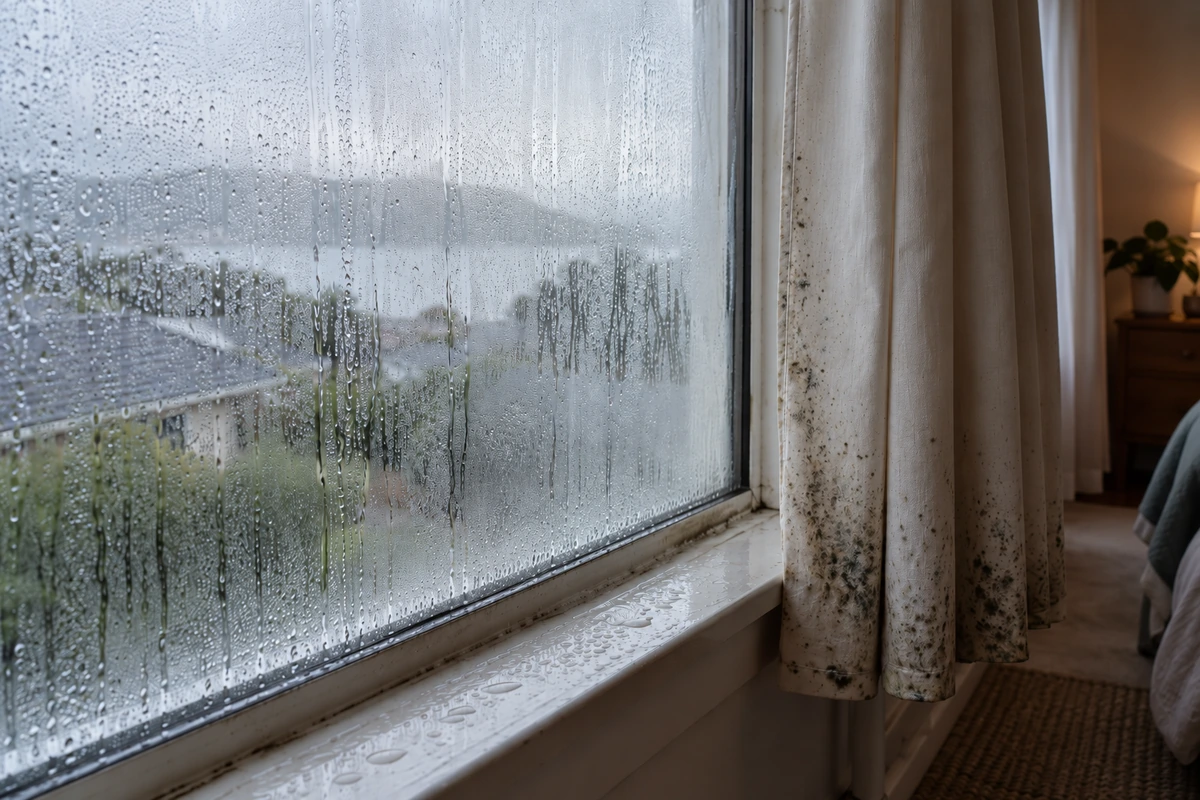
Droplets or films on the room-facing glass, especially in bedrooms early in the morning, commonly indicate moist indoor air encountering cold glazing. Single glazing and metal frames are particularly susceptible. Water may run down onto sills, damaging timber paintwork, MDF architraves or adjacent wall linings if it remains there repeatedly.
Condensation on aluminium frames and at glass edges
The glass may be relatively dry while the surrounding metal frame or edge of the unit is wet. Aluminium conducts heat readily, allowing interior frame surfaces to become cold. Spacer materials, thermal breaks and frame design affect performance, so not all double-glazed joinery behaves alike.
If droplets appear between the two panes of a sealed double-glazed unit, rather than on an accessible glass surface, the unit’s edge seal may have failed. Ventilating the room cannot remove moisture trapped inside a failed sealed unit; a glazing specialist should assess replacement options.
Mould on corners, ceilings and behind furniture
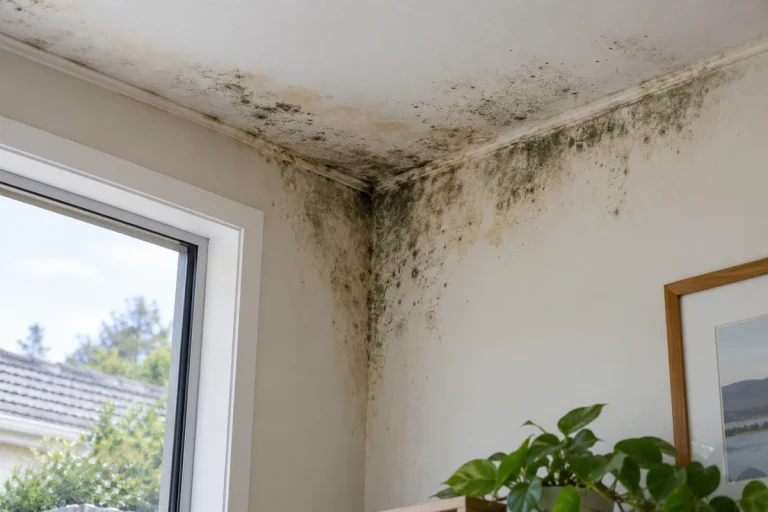
Recurring speckled mould may develop where indoor humidity meets cold, poorly ventilated surfaces. Common locations include external wall corners, wardrobe backs, window reveals, ceiling junctions and the space behind large furniture placed against outside walls.
A wall can appear superficially dry even when local surface humidity is sufficient for mould growth. Visible mould does not, by itself, identify the cause. Staining that follows rain or spreads through wall materials may indicate a leak; our Damp Walls & Cladding guide addresses that different investigation.
Condensation on ceilings or in roof spaces
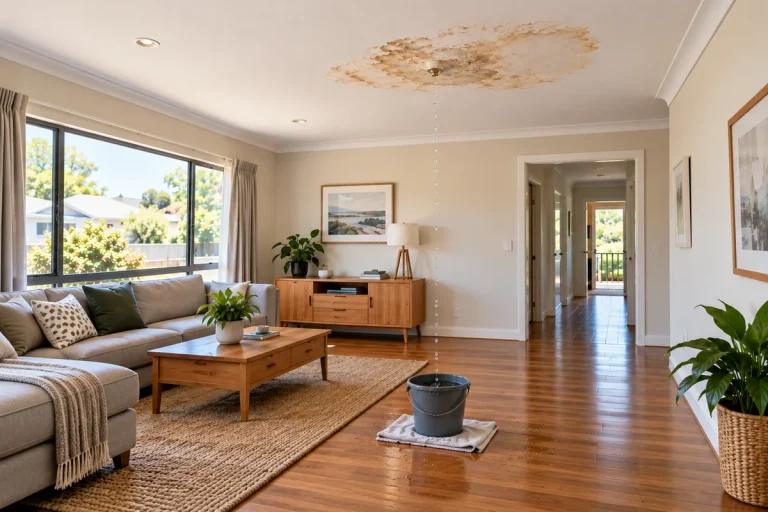
Some ceilings develop dark or damp patches near cold framing lines. The pattern may arise from temperature differences and inadequate insulation, but roof-space condensation or external water ingress must be considered where symptoms are unexplained. Water dripping from above a ceiling is not automatically indoor condensation; the Ceiling Leaks guide helps distinguish possible sources.
A useful pattern comparison
| Observation | Likely first question |
|---|---|
| Moisture on the room side of glass during cold mornings | Are indoor humidity and glass temperature combining to cause condensation? |
| Cloudiness trapped between panes of double glazing | Has the sealed glazing unit failed? |
| Mould behind furniture on an external wall | Is a cold, poorly circulated surface involved? |
| Water near a window only during wind-driven rain | Could joinery or flashing be leaking instead? |
| Condensation after showers or cooking | Is extract ventilation removing moisture outdoors? |
| Persistent wall staining unrelated to occupancy | Is there a concealed building or plumbing defect? |
These are starting points, not diagnoses.
3. Understanding the Possible Causes
Condensation is usually the result of a mismatch between indoor vapour levels and the temperature of building surfaces. The practical causes can be grouped into moisture generation, inadequate removal, insufficient warmth and localised cold surfaces.
Moisture from normal household activities
Showering, cooking, boiling water, washing dishes and drying clothing release water vapour. Occupants also contribute through breathing and ordinary daily activity. The amount depends on household size and routines, but the mechanism is consistent: moisture stays in the home unless it is extracted, ventilated or condensed onto a surface.
A busy bathroom used repeatedly can produce short, intense humidity peaks. An open-plan kitchen without effective outward extraction can spread cooking vapour into adjoining rooms. Drying several loads of laundry indoors is a sustained moisture source, especially in a closed house during winter.
Ineffective kitchen and bathroom extraction
An extractor may run audibly without moving enough air to clear the room. Causes include undersized fans, long or restrictive ducting, blocked grilles, poor make-up air and incorrectly installed outlets. A rangehood that recirculates air through a filter can remove some grease or odours but does not expel cooking moisture outdoors.
This moves humid air out of the bathroom but deposits it around roof framing and insulation. Exhaust should reach an appropriate external outlet in accordance with the applicable design and requirements.
Fans should ideally operate during moisture-producing activities and long enough afterwards to clear residual humidity. Timers or humidity controls may help, but a sensor does not compensate for an inadequate duct or disconnected exhaust.
Inadequate whole-home air exchange
Even where bathrooms have suitable extraction, bedrooms and living spaces require an appropriate supply of fresh air. Occupied rooms can accumulate humidity overnight when doors and windows are closed. Natural ventilation through openable windows may be useful, but performance depends on outdoor conditions, wind, opening location and occupant behaviour.
More airtight construction can reduce uncontrolled heat loss, which is beneficial, but makes intentional ventilation more important. Simply sealing every draught without considering fresh-air provision can worsen indoor air quality and moisture build-up.
Cold glazing and inefficient frames
Single-glazed windows commonly have interior surfaces much colder than the surrounding room. Conventional aluminium frames may be colder still because heat passes readily through metal. Double glazing usually raises the inner glass temperature, but the benefit varies with glass coating, spacer type, frame material and installation details.
Warm-edge spacers, thermally broken aluminium, timber or suitable uPVC frames can reduce local cold spots. Poorly fitted new joinery or remaining thermal bridges may still permit edge condensation, so the whole-window system matters more than a headline glass specification.
Thermal bridges and gaps in insulation
A thermal bridge occurs where heat moves comparatively easily through an element, such as a framing member, a metal connection or an uninsulated junction. This creates a locally colder internal surface. Patchy ceiling insulation can produce visible differences between ceiling panels and framing lines. Wall corners and window reveals may also be vulnerable because of their geometry and construction.
Cold-surface mould can therefore recur despite apparently acceptable humidity elsewhere. Adding insulation can help, but the design must consider moisture movement and existing wall construction. Filling a wall cavity without assessing its weathertightness and ventilation arrangements may be inappropriate.
Insufficient or intermittent heating
When a house becomes very cold overnight, window and wall temperatures fall. Turning a heater on briefly in the morning may warm the air faster than the surfaces, leaving condensation conditions temporarily unchanged. Better temperature control and adequate insulation help keep surfaces warmer for longer.
Portable unflued LPG heaters create an additional problem: burning gas produces water vapour indoors as well as introducing combustion-related health risks. They are not an appropriate moisture-control strategy. A properly installed heat pump or other suitable fixed heater can improve comfort when correctly sized and operated.
Hidden moisture sources and building defects
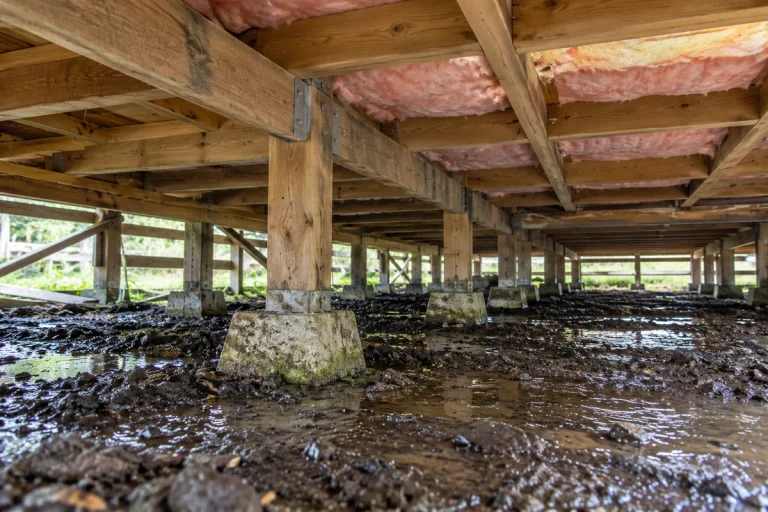
Ground moisture entering through a damp subfloor, leaking plumbing or external water ingress can increase the moisture burden in a home. These should not be blamed on occupant behaviour. Where there are unexplained damp patches, softened materials or water linked to storms, investigation may need to extend beyond condensation control. Our Subfloor Dampness guide deals with ground vapour, drainage and timber-floor conditions.
4. Assessing Seriousness and Urgency
Most ordinary window condensation is not an emergency. The need for action increases where water persists, affects vulnerable materials, supports extensive mould growth or may be concealing a different defect.
Lower urgency: occasional visible droplets
A small amount of water on bedroom glass on a cold morning, with dry sills and no deterioration, can be an early prompt to review moisture production, airing and room temperature. It may be manageable through practical household changes. Track whether the condition improves rather than assuming nothing further can be done.
Moderate urgency: recurring wetting and material damage
Water running onto timber sills each morning, repeated mould behind furniture or swollen joinery requires more than routine wiping. The affected surfaces may be experiencing long periods of elevated moisture. Assess extraction, indoor humidity, heating and insulation, and arrange targeted advice where simple measures have not resolved the problem.
Higher urgency: possible hazards or concealed failure
Keep clear of any electrical installation being wetted. Extensive mould, visibly deteriorated linings or unexplained dampness in a roof or wall assembly warrants appropriate assessment. Water entering during rain or appearing at one particular penetration may indicate external leakage or plumbing; treating it solely as condensation can allow concealed damage to continue.
Where respiratory symptoms are concerning, a healthcare professional can advise on individual health risks; a building specialist can investigate the environment. A homeowner does not need to identify a mould species before addressing persistent moisture and the conditions supporting growth.
Respond to the mechanism, not the appearance
Dark staining, condensation and leakage can overlap visually. Surface water that wipes off glass is different from moisture appearing between sealed panes or through painted plasterboard. The level of intervention should be based on evidence of source and consequence rather than a photograph alone.
5. What the Homeowner Should Investigate
A practical investigation can often begin with inexpensive observations. The objective is to establish when condensation occurs, what produces the moisture, and which surfaces are cold enough for water to form.
Map the rooms and time of day
Record which windows, walls or ceilings are affected, and whether symptoms peak overnight, after showers, during cooking or after laundry has been dried inside. Note outside weather and whether the room was heated. Photograph recurring locations so that changes are visible over time.
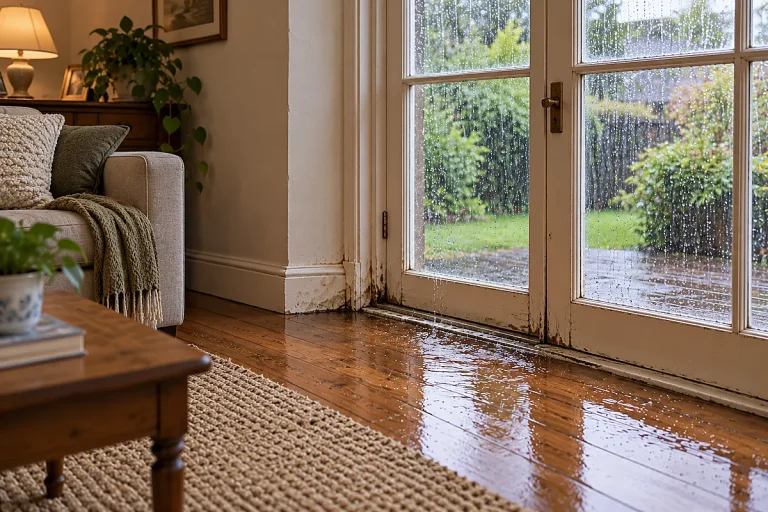
If moisture occurs only during wind-driven rain at a particular window junction, investigate weatherproofing rather than assuming humidity is responsible. The Window & Door Leaks guide explains how to investigate that distinct possibility.
Use a hygrometer intelligently
A basic digital hygrometer provides room temperature and relative humidity. It can be useful for comparing rooms and times; it is not a building moisture meter. As a practical comfort and moisture-management guide, many homeowners aim to keep indoor relative humidity broadly around 40–60%, but no single reading is an absolute safety threshold or guarantee against condensation.
A 55% reading in a warm room can still produce droplets if the window is exceptionally cold. Conversely, a higher reading briefly after a shower may be less concerning if effective extraction rapidly returns the room to normal conditions. Log readings over several days rather than drawing conclusions from one measurement.
Observe the extraction system in use
Check that the bathroom fan switches on, the grille is reasonably clean and air is being discharged at an appropriate outside outlet. A rangehood should be identified as externally ducted or recirculating. A simple tissue test may suggest airflow at a grille, but it does not verify the installed extract rate or prove that ductwork is correctly connected.
If a fan is noisy, weak, dripping or ineffective, ask an installer to check duct length, outlet condition and actual performance. Electrical components should be assessed by a suitably licensed worker.
Look for cold spots and missing insulation
Notice whether condensation clusters around metal frames, corners, poorly fitting window reveals or particular ceiling lines. Check accessible insulation records and previous renovation information. A thermal image can identify surface-temperature differences, but images require interpretation and cannot alone prove missing insulation or a leak.
Where older wall or ceiling materials may contain asbestos, avoid removing samples or making investigative holes yourself.
Check household moisture sources without assigning blame
Identify whether bathroom doors are left open while showering, whether the extractor operates long enough, and whether wet clothes are dried inside without ventilation. Also consider whether a large household occupies small rooms overnight. These are practical inputs into moisture management, not proof that the building performs adequately.
A landlord or property owner should not treat occupant behaviour as a substitute for required ventilation, heating, drainage or building repairs. Where symptoms persist despite reasonable use, independent building assessment may be appropriate.
Know when to escalate the investigation
A building surveyor, ventilation specialist or glazing expert may be needed if condensation is widespread, one room differs markedly from others, mould repeatedly returns, or moisture appears concealed. A structured assessment should distinguish indoor humidity, low surface temperature, poor air circulation, failed glazing and active water entry before recommending equipment.
6. Available Solutions and Repair Pathways
Condensation control is usually most effective when measures are combined in a sensible order. Low-cost changes may reduce the moisture burden, while persistent cold-surface problems can require insulation, glazing or properly designed ventilation work.
Option 1 — Reduce moisture at its source
Where practical, dry laundry outside or in a suitably vented dryer; use lids when cooking; run kitchen extraction during moisture-producing activities; and keep bathroom doors closed during showers while the fan operates. Avoid unnecessary indoor moisture from unflued gas heaters. These measures reduce the amount of vapour that later needs removing.
If drying clothes inside is unavoidable, use a well-controlled ventilated or dehumidified space rather than allowing moisture to spread through the entire home. The aim is to manage real household needs, not suggest that ordinary cooking, bathing or occupancy should stop.
Option 2 — Improve bathroom and kitchen extraction
An appropriately sized, externally ducted fan removes moisture close to where it is generated. The system must have suitable airflow at the installed duct length, not just an impressive rating on the product box. Ducting should be correctly routed and sealed, and the exterior outlet positioned to avoid re-entry or damage.
Timers, run-on controls and humidity sensing can improve operation where suitable. Rangehood choice should reflect cooking intensity and installation constraints. Maintenance includes cleaning filters and ensuring outlets are not obstructed. A recirculating rangehood is not equivalent to a moisture-extracting system that vents outdoors.
Option 3 — Establish effective general ventilation
Opening windows briefly when outdoor conditions permit can remove accumulated indoor moisture without leaving rooms chilled all day. EECA recommends airing homes for around 10–15 minutes each morning, alongside reducing sources of moisture and maintaining appropriate warmth.
Some houses benefit from an engineered continuous ventilation solution. Positive-pressure, balanced supply-and-extract and mechanical ventilation with heat recovery are different technologies; their suitability depends on airtightness, climate, roof-space conditions, ducting and desired indoor-air quality. A positive-pressure system that draws air from a roof cavity does not necessarily provide the performance of a balanced heat-recovery system. Ask for a design based on the actual building and a clear explanation of how humid air leaves the dwelling.
Option 4 — Heat rooms adequately and consistently
Keeping occupied areas comfortably warm raises surface temperatures and can lower the likelihood of condensation. EECA’s household advice commonly recommends operating heat pumps around 18–21°C, with appropriate adjustment for household needs. The required heating capacity depends on room size, construction and location.
A heat pump can supply efficient heating, but a single unit in the lounge may not adequately warm closed bedrooms. Portable electric heaters add warmth without adding water vapour, yet running costs and fire safety matter. Heating alone does not remove moisture: extraction and ventilation remain necessary.
Option 5 — Improve insulation and address thermal bridges
Continuous, correctly installed ceiling, floor and wall insulation can help keep internal surfaces warmer. EECA explains the importance of the complete thermal envelope, including gaps and thermal bridges. Addressing a poorly insulated ceiling may be more proportionate than immediately replacing every window.
Upgrading walls requires greater care. The existing cladding, cavity arrangement and weatherproofing must be assessed so new work does not increase concealed moisture risk. Window reveals, ceiling junctions and framing bridges may need specialist detailing. Seek design advice where significant retrofitting is planned rather than assuming that adding more insulation in one location is always beneficial.
Option 6 — Improve window thermal performance
Low-cost measures include well-fitted curtains, appropriate blinds and temporary secondary-glazing film where suitable. Film needs compatible, sound frames and careful installation. EECA’s window-insulation guidance explains the potential benefits and limitations of these options.
Double-glazed units with low-E coatings, appropriate gas fills and warm-edge spacers can improve performance. Frame materials and thermal breaks also influence condensation at edges. The best option depends on frame condition, glass dimensions, heritage considerations and budget.
Double glazing does not remove indoor humidity. If the house continues producing more vapour than ventilation removes, condensation may shift to colder wall corners or other surfaces. The glazing investment should therefore form part of a wider moisture and thermal-performance plan.
Option 7 — Use dehumidification where appropriate
A dehumidifier actively removes water from indoor air and may provide practical relief in bedrooms, laundries or intermittently occupied spaces. Capacity and performance vary with room temperature, ventilation and appliance type. In cool conditions, some compressor-based models lose effectiveness; other technologies may suit those environments but have different energy demands.
Choose a unit suitable for the room and empty or drain it safely. Treat collected-water volume as evidence of removal, not proof that the underlying source has been fixed.
When a coordinated upgrade makes more sense
For a cold, single-glazed 1960s house with poor bathroom extraction, patchy ceiling insulation and overnight bedroom humidity, no single upgrade addresses every mechanism. Prioritising effective extraction, suitable heating and insulation, then assessing glazing may deliver more value than choosing the most expensive intervention first. The correct sequence follows the property’s evidence and budget.
7. Costs and Financial Considerations
Condensation improvements range from no-cost operating changes to substantial building upgrades. Costs depend on electrical work, duct routes, heating capacity, the area of glazing and whether existing joinery or building materials need remediation.
Indicative New Zealand budgeting allowances
The figures below are broad 2026 planning allowances in NZ dollars, generally including GST, informed by published contractor and product pricing. They are not verified national averages or quotations.
| Measure | Indicative allowance |
|---|---|
| Hygrometer and simple monitoring | $15–$70 |
| Temporary secondary glazing film | $30–$120+ per window, depending on size and kit |
| Portable dehumidifier | $250–$800+ |
| Supplied and installed bathroom extractor | $300–$900+ |
| Externally ducted kitchen rangehood installed | $500–$2,000+ |
| Standard high-wall heat pump installed | $2,000–$5,000+ |
| Whole-home positive-pressure ventilation | $2,500–$5,500+ |
| Balanced heat-recovery ventilation | $6,500–$12,000+ |
| Retrofitted double glazing | Commonly hundreds per window; substantial house-wide cost |
| Complete replacement joinery | Usually significantly more than glass-only retrofitting |
These are not interchangeable alternatives. A dehumidifier, extraction system and window replacement address different parts of the problem and should be costed against the defect they are intended to resolve.
Example: staged improvements in a three-bedroom home
Suppose a 1970s house has morning window condensation, limited bathroom extraction and a cold living space. A first stage might involve monitoring humidity, improving routines and installing a properly ducted bathroom fan for an allowance of several hundred dollars. If the living room remains inadequately heated, a suitably sized heat pump may be the next major expenditure.
Only after reviewing the result should the owner compare targeted bedroom window improvements, further insulation or a whole-home ventilation system. This sequence does not guarantee that every window will stay dry, but it allows each investment to be evaluated rather than committing immediately to a house-wide glazing project.
Understand installation and running costs
Mechanical ventilation and dehumidifiers use electricity; filters and servicing may add ongoing expense. Heat pumps use energy too but can deliver more heat than their electrical input through their operating cycle. Compare expected running conditions and performance rather than price alone.
For window upgrades, ask whether the quote includes removal and disposal, frame repairs, reveals, finishing, access, building consent where required, glass specification and warranties. A low per-pane price may not represent the cost of a complete weatherproof installation.
Financial support and future property value
Depending on current eligibility, a household may be able to access energy-efficiency assistance or installation support. Check EECA’s current homeowner information rather than assuming a particular grant is available.
A warm, well-ventilated, properly insulated home may appeal to future buyers, but no specific increase in sale price is guaranteed. Documentation of compliant installations and repairs is more useful than unverified claims that a product has permanently eliminated moisture problems.
8. Legal, Regulatory and Consent Requirements
The regulatory position differs between an existing owner-occupied home, a rental property and new or altered building work. A manufacturer’s claim that a product ‘meets Healthy Homes’ is not enough to establish that the overall property or installation complies.
Building Code E3, G4 and H1
Building Code clause E3 Internal Moisture concerns avoiding fungal growth and excessive moisture, including provisions related to ventilation, thermal resistance and wet-area surfaces. G4 Ventilation sets ventilation performance requirements for occupied spaces and removal of moisture and other contaminants. H1 Energy Efficiency can govern the thermal performance of new or altered building work, including applicable glazing and insulation provisions.
The relevant acceptable solutions and compliance pathways depend on the work and the version applicable to the project. Existing homes are not automatically required to replace all original single glazing simply because current standards for new construction differ.
Healthy Homes ventilation rules for rentals
The Healthy Homes ventilation standard generally requires openable windows or doors in habitable spaces and appropriate kitchen and bathroom extraction, subject to specific exceptions. For extractor fans installed after 1 July 2019, the kitchen fan must have at least a 150 mm diameter including ducting or exhaust capacity of 50 litres per second; a bathroom fan must have at least 120 mm diameter including ducting or capacity of 25 litres per second. These are alternative compliance criteria, not requirements to satisfy both measurements.
An existing fan installed before that date can qualify if it extracts outdoors and remains in good working order, subject to the standard. Certain qualifying continuous mechanical-extraction systems may satisfy the requirement instead. Ordinary recirculating rangehoods or supply-only positive-pressure systems do not meet the direct extraction requirement for wet areas.
Healthy Homes heating, insulation and draught stopping
The Healthy Homes heating standard requires qualifying fixed heating capable of meeting the required capacity for the main living room. It is not simply a requirement to install any heat pump regardless of size, nor does it prescribe fixed heating in every bedroom. The insulation standard covers specified ceiling and underfloor requirements, while the draught-stopping standard addresses unreasonable gaps and holes. These obligations work alongside ventilation but should be assessed separately.
Landlords must retain appropriate compliance information and records. Tenants concerned about unresolved condensation should communicate evidence of symptoms and any defects; the existence of condensation alone does not automatically establish a particular breach without considering the applicable standards and circumstances.
Building consent, glazing and ventilation alterations
Replacing glass, altering joinery, installing fans, adding ducts or carrying out insulation retrofits can involve different consent exemptions and building requirements. Like-for-like maintenance may be exempt in some circumstances, but significant alterations affecting structure, external weathertightness, fire separations or means of escape need proper consideration. Work exempt from consent must still comply with relevant Building Code requirements.
Check MBIE’s building consent guidance before substantial work. Electrical installation must be carried out by appropriately authorised people, and penetrations through external walls or roofs must be weatherproofed correctly. If work involves shared apartment structures or a unit title, additional ownership approvals may be relevant.
Contracts, records and product claims
For residential building work costing $30,000 or more including GST, the Building Act’s consumer-protection provisions require a written contract and prescribed pre-contract disclosures. These should also be provided when requested below the threshold. See MBIE’s contracts guidance.
Keep installer details, electrical certificates where applicable, ventilation performance information, glazing specifications, warranties and any relevant consent records. Clear documentation helps future maintenance and provides evidence of what was actually installed.
9. Which Professionals May Be Required?
Many condensation problems can be improved through better moisture management, appropriate heating and effective ventilation without immediately engaging a contractor. Where condensation persists, causes damage or requires substantial building improvements, the appropriate professional depends on whether the underlying issue involves ventilation, insulation, heating, glazing or a possible concealed moisture defect.
A building inspector or building surveyor may be a suitable starting point when the cause is uncertain, while a specialist contractor may be more appropriate when a specific problem has been established. The professional who investigates the cause may differ from the person required to undertake improvements or repairs.
Building inspector or building surveyor
An experienced surveyor can help distinguish surface condensation from weathertightness, plumbing or concealed-moisture defects. An investigation may include accessible building elements, temperature patterns, moisture measurements and inspection of insulation. Confirm the scope and limitations before booking.
Electrician or ventilation specialist
A suitably registered electrical worker can address fan wiring and electrical safety. A ventilation designer or experienced installer can assess extract capacity, ducting, make-up air, noise and suitability of whole-home systems. Ask for installed-performance evidence, not only a product brochure or nominal fan rating.
Heating and insulation contractor
Heating specialists can assess room heat losses and appropriate heat-pump capacity. Insulation installers should review access, existing condition, product specification and effects on ventilation or concealed moisture. Work spanning several elements may benefit from a broader building-performance assessment.
Glazier and joinery specialist
A glazier can assess sealed double-glazing failure, retrofit suitability and glass options. A joinery specialist may be needed where timber or metal frames require repair, drainage adjustment or replacement. Any proposed joinery change should preserve the building’s weatherproofing and applicable requirements.
Weathertightness or design specialist
If moisture is within walls, at roof junctions or behind linings, a building surveyor, designer or other specialist may be more suitable than a condensation-product salesperson. The aim is to establish what evidence supports each proposed solution before irreversible work begins.
10. Common Mistakes and Avoidable Risks
The most expensive condensation mistake is treating every damp surface as proof that one piece of equipment is missing. A measured response looks at vapour production, air exchange and surface temperature together.
Buying double glazing without addressing humidity
Better glazing generally raises glass temperature and improves comfort, but cannot remove vapour generated indoors. If high humidity persists, moisture may appear on the next coldest surface. Compare extraction and heating needs before committing to a full joinery replacement.
Using a dehumidifier as a substitute for ventilation
A dehumidifier removes water from air but does not reliably supply fresh outdoor air or remove all indoor contaminants. It may be useful as part of a plan, particularly in difficult rooms, but should not be used to disguise a failed extractor or unaddressed leak.
Installing a fan that exhausts into the roof cavity
This relocates humid air rather than removing it from the building. Roof-space wetting can then cause staining or deterioration. Check the actual external termination and duct condition instead of assuming that a noisy running fan is effective.
Closing every ventilation path while draught-proofing
Controlling unintended draughts can improve warmth, but an airtight home still needs designed fresh-air provision. Do not block permanent ventilation openings or make changes that compromise the intended system. Insulation, air sealing and ventilation should work together.
Confusing glazing-unit failure with indoor condensation
Clouding between sealed panes normally involves the glazing unit, not household humidity on an accessible surface. Cleaning the room-side glass or opening a window will not restore the failed sealed unit. A glazier should assess the appropriate remedy.
Painting over recurring mould or cold-surface staining
Repainting without addressing the moisture conditions often produces repeat damage. Cleaning may be needed, but extensive contamination or deteriorated materials should be professionally assessed. The responsible moisture mechanism must be corrected before finishes are restored.
Relying on a single humidity reading
Relative humidity changes with temperature and time. A reading taken in a warm living room at midday may not represent a closed bedroom overnight. Combine readings with surface conditions, occupancy patterns and evidence of existing damage.
Accepting undefined performance claims
Terms such as ‘whole-home dry air’, ‘condensation-free’ or ‘maintenance-free’ require scrutiny. Ask how performance will be measured, what assumptions apply and whether quoted savings or outcomes are supported for the particular home.
11. Making an Informed Decision
The most suitable solution depends on whether the problem is dominated by high indoor moisture, cold surfaces, ineffective extraction or a combination. These examples show why different houses with wet windows may need different investments.
Scenario A — Single-glazed bedrooms in an older bungalow
Two bedrooms develop heavy morning condensation. A hygrometer shows that humidity rises overnight, while the windows and aluminium frames are exceptionally cold. The bathroom fan operates properly and there is no evidence of leaks.
Reasonable first steps may include reviewing bedroom heating and airing, ensuring adequate insulation and considering temporary secondary glazing. A future glazing upgrade could improve comfort, but the owner should compare the benefit against the whole-house thermal condition before replacing otherwise serviceable joinery.
Scenario B — Bathroom mould despite a running fan
A bathroom has recurring mould on the ceiling after regular showering. The fan is noisy but weak; inspection finds a long, crushed duct and an outlet that does not discharge correctly outside. Replacing paint or installing an expensive central ventilation unit would not address the most obvious defect.
The priority is a properly sized, commissioned extract system with suitable ducting and an external outlet. Existing material damage should be assessed and cleaned or repaired appropriately after moisture control is restored.
Scenario C — New double glazing but persistent wall-corner mould
Following a glazing upgrade, water no longer collects on the centre of the glass, yet dark patches recur behind a large wardrobe. Investigation identifies a cold external corner and very little air circulation behind the furniture.
The next decision concerns the wall’s thermal performance, furniture clearance and overall indoor humidity. Replacing the new glass or repeatedly treating the wall surface without investigating the cold bridge would be unlikely to provide durable value.
Scenario D — A newer, airtight home with stale bedrooms
A well-insulated modern house feels warm but has stuffy bedrooms and high overnight humidity. The opening windows are rarely used, and extraction is limited to occasional bathroom fan operation. A professional may recommend reviewing how the installed systems are operated or assessing a designed continuous supply-and-extract arrangement.
The solution should be compatible with the home’s airtightness and actual air-change needs. Drawing uncontrolled air from a damp roof cavity is not equivalent to designing balanced ventilation.
Scenario E — Water mistaken for condensation
A homeowner finds a wet window reveal and assumes that poor glazing is responsible. The patch becomes wet only during wind-driven rain, while other window surfaces remain dry. A building inspection identifies a junction requiring weathertightness assessment.
Condensation equipment would not correct that defect. The appropriate path is investigation and repair of water entry, with the status of surrounding materials established before internal finishes are reinstated.
A practical improvement framework
Before committing to significant expenditure, establish:
- Mechanism: Is the water forming from indoor vapour or entering from another source?
- Pattern: Which rooms and surfaces are affected, and at what times?
- Moisture load: What activities and defects add humidity, and how is it removed?
- Temperature: Are glazing, frames, insulation or thermal bridges creating cold surfaces?
- Options: Which low-cost and capital improvements address the documented causes?
- Compliance: What rental, Building Code, electrical or consent requirements apply?
- Value: Can upgrades be staged and evaluated before larger investment?
- Verification: How will reduced condensation and improved indoor conditions be assessed?
A proportionate decision treats condensation as a measurable building-performance issue, not a reason to buy one standard product for every property.
12. Your Recommended Next Steps
The following sequence provides a practical approach to persistent condensation while preserving the distinction between simple surface moisture and potentially concealed building defects.
Your Condensation Action Plan
Step 1 — Check for immediate hazards
Keep water away from electrical installations. Seek appropriate advice where extensive mould, deteriorated materials or hidden moisture may be involved. Do not disturb suspect materials to investigate the cause.
Step 2 — Record where and when moisture occurs
Photograph affected windows, frames and wall areas. Note the time of day, weather, room use and whether moisture is on accessible glass or trapped between panes.
Step 3 — Measure indoor conditions
Use a basic hygrometer to record temperature and relative humidity in affected rooms at different times. Look for recurring patterns, not a single target number.
Step 4 — Check moisture sources and extraction
Review bathroom and kitchen extraction, clothes drying and heating arrangements. Confirm that fans discharge outdoors and operate effectively, using professional checks where needed.
Step 5 — Assess cold surfaces and insulation
Consider single glazing, metal frames, uninsulated corners, patchy ceiling insulation and rooms that remain cold overnight. Seek building-performance advice if symptoms persist or are concentrated in one location.
Step 6 — Compare the appropriate solutions
Start with practical, low-cost moisture-management improvements before considering substantial expenditure. Where professional assistance is necessary, select the appropriate specialist based on the identified problem — such as a ventilation specialist for ineffective extraction, a heating or insulation contractor for cold rooms, or a glazing specialist for window-related issues. If the cause remains uncertain or concealed moisture is suspected, consider an independent building surveyor before committing to major improvements.
Step 7 — Confirm costs and regulatory requirements
Obtain defined quotations, verify practitioner competence and check applicable rental, Building Code and consent requirements. Ask what performance evidence and warranties will be provided.
Step 8 — Verify results and retain records
Review conditions during comparable weather after changes are made. Keep humidity notes, photographs, specifications, invoices and any compliance documentation; investigate remaining unexplained dampness rather than concealing it.
Final consideration
Condensation is neither inevitable in every New Zealand winter nor automatically evidence of a major building defect. It occurs when indoor moisture and cold surfaces meet, and it can often be reduced by controlling vapour sources, removing moist air and improving thermal performance. Persistent water damage, concealed dampness or uncertainty about the source calls for a more detailed investigation.
The best outcome is a comfortable, well-ventilated home in which moisture is managed at its source and improvements are chosen for their actual performance—not simply because a particular product promises dry windows.