Water Leaking Through Your Ceiling? What NZ Homeowners Should Do First
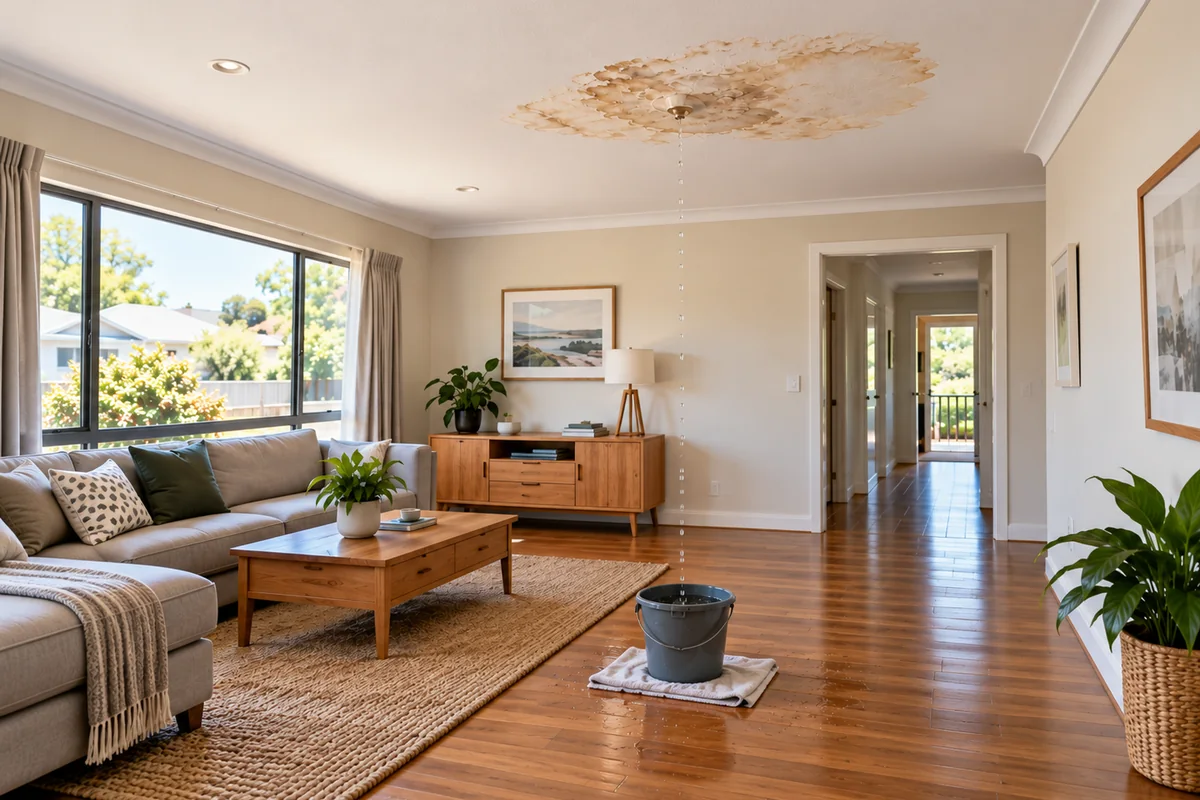
Water leaking through your ceiling can appear as a spreading stain, an unexpected drip during heavy rain or moisture around a light fitting. Although a roof leak may seem the obvious cause, water can also originate from an upstairs bathroom, concealed plumbing, defective flashing or condensation accumulating within the roof space.
The important first step is to establish whether the situation is dangerous. After that, the challenge is to identify where the water is coming from and determine the most appropriate repair.
This guide explains how New Zealand homeowners can distinguish potential causes, assess the seriousness of ceiling leaks, understand investigation and repair options, and make informed decisions before spending money on remedial work.
Safety first: If water is reaching electrical fittings, a ceiling is bulging or sagging, or substantial amounts of water are entering, keep people away from the area and seek urgent professional assistance. Do not touch wet electrical equipment or attempt to puncture a water-filled ceiling. If anyone is in immediate danger, call 111.
1. Understanding the Problem
A ceiling leak occurs when water reaches an internal ceiling surface from somewhere above or within the surrounding building structure. Depending on the construction of the home, that water may originate directly above the damaged area or have travelled some distance before becoming visible.
In a typical single-storey New Zealand home, the ceiling separates living spaces from the roof structure and roof cavity. Above the plasterboard or other ceiling lining may be insulation, timber framing, electrical wiring, ducting and, in some properties, plumbing installations.
In a two-storey house, the space above a ground-floor ceiling may contain floor framing, water supply pipes, wastewater pipes or a bathroom. These different arrangements are important because they determine which potential causes should be investigated first.
Water does not always travel vertically. It may run along roof underlay, timber framing, pipes, cables or structural components before eventually dripping onto the ceiling lining. Consequently, the location of a stain does not necessarily identify the actual point of entry.
Why even a small leak matters
Water-damaged plasterboard may require only limited replacement if the source is identified early and surrounding materials remain sound. However, persistent moisture can affect insulation, timber framing and concealed components.
The apparent size of a stain is therefore an unreliable measure of the total damage.
Consider a small brown mark near the edge of a bedroom ceiling. The visible discolouration may occupy only a few centimetres, but the water could be entering at a roof junction several metres away and travelling along framing before reaching that position.
Conversely, a relatively large stain may result from a single plumbing incident that has already been stopped.
The appropriate response depends on the cause, duration, location and condition of the affected materials — not simply the appearance of the stain.
2. Recognising the Signs and Symptoms
A ceiling leak does not always begin with water dripping into a room. In many cases, the earliest signs are changes in the appearance or condition of the ceiling lining.
Common warning signs
Brown, yellow or irregular stains
Discolouration may indicate that water has passed through the ceiling lining, carrying contaminants or affecting the surface finish. A stain that expands or reappears after repainting suggests the underlying problem may remain unresolved.
Bubbling or peeling paint
Moisture may weaken the bond between the paint coating and the underlying plasterboard or other lining material. Blistering or peeling paint can occur after a leak even when the surface appears dry.
Sagging or bulging ceiling material
Plasterboard becomes vulnerable when saturated. A ceiling that visibly sags, bulges or separates at its joints may be carrying trapped water or have lost some of its integrity.
This should be treated as a potential safety concern, rather than simply a cosmetic defect.
Water dripping from ceiling joints or penetrations
Water may appear around downlights, ceiling roses, ventilation grilles or joints between sheets of plasterboard. These openings can provide convenient exit points for water travelling above the ceiling.
They do not necessarily identify the original source.
Musty odours or recurring mould
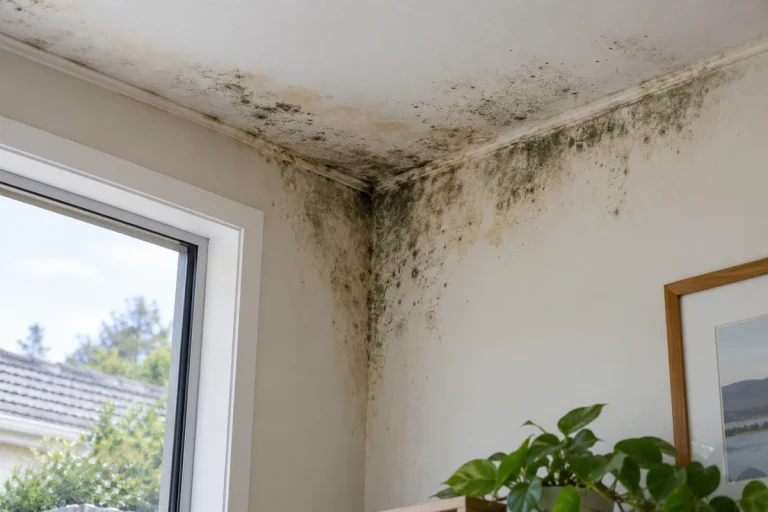
Persistent moisture within ceiling materials or roof spaces may contribute to mould growth and unpleasant odours. However, mould can also develop because of condensation or inadequate ventilation, so its presence alone does not prove that the roof is leaking.
When the leak occurs is an important clue
| Observation | Possible explanation |
|---|---|
| Water appears during heavy rain | Roofing, flashing, guttering or external weatherproofing defect |
| Leak occurs mainly during wind-driven rain | Vulnerable roof junction, penetration or flashing |
| Moisture appears after someone showers upstairs | Plumbing, shower waterproofing or drainage defect |
| Water appears continuously, regardless of weather | Possible pressurised water-supply leak |
| Ceiling dampness follows use of a bath, basin or washing machine | Wastewater connection, overflow or plumbing problem |
| Moisture develops in cold weather without rainfall | Possible condensation or indoor moisture issue |
These observations are useful for narrowing the possibilities. They are not definitive diagnoses.
A roof leak and a plumbing leak can exist simultaneously, and some symptoms may only become apparent after water has accumulated for an extended period.
3. Understanding the Possible Causes
The main causes of ceiling leaks can be grouped into several categories.
Roofing materials and roof-covering defects
New Zealand homes use a wide variety of roof coverings, including long-run metal roofing, pressed metal tiles, concrete and clay tiles, membrane roofs and other systems.
Each has its own maintenance requirements and potential failure points.
For example, a metal roof may develop problems around fixings, penetrations, laps or flashings. A tiled roof may be affected by displaced or damaged tiles, deteriorated underlay or defective junctions.
Low-slope and membrane roofing systems require particular attention to drainage, outlet details, membrane condition and junctions with other building elements.
The presence of an older roof does not necessarily establish that it requires replacement. An appropriately qualified roofer should distinguish between a localised defect and deterioration affecting the overall roofing system.
Flashings, roof junctions and penetrations
Flashings are essential elements of a roof’s weatherproofing system. They help manage water where roofing meets walls, chimneys, skylights, vents and other building components.
These junctions can be more vulnerable than uninterrupted roof surfaces because they depend on correct detailing, suitable materials and proper installation.
A skylight leak, for example, may involve the flashing system rather than the glazing itself. Similarly, water appearing near a chimney may originate from the roof-to-chimney junction.
Applying sealant over the visible joint may provide temporary protection in some circumstances, but it is not a substitute for establishing whether the underlying flashing arrangement is appropriate.
Gutters, valleys and blocked roof drainage
Valley gutters collect water from adjoining roof slopes and direct it towards the roof’s drainage system.
Leaves, debris, corrosion, inadequate falls or blocked outlets can interfere with that process.
Water may then overflow into locations not designed to accommodate it, particularly during heavy rainfall.
An overflowing external gutter can also contribute to water entering around fascia boards, eaves or adjoining construction, depending on the building’s design.
Leaking pipes above the ceiling
In two-storey homes, water supply and wastewater pipes may pass through the floor cavity above a ground-floor ceiling.
A leaking pressurised pipe may release water continuously, while a defective wastewater connection may only leak when a particular plumbing fixture is used.
A useful example is a ceiling stain directly beneath an upstairs bathroom.
If the stain becomes wet after the shower is used but remains dry during heavy rain, the evidence points towards investigating the bathroom and its plumbing before assuming a roofing defect.
The precise cause could still involve supply plumbing, drainage, waterproofing or the shower enclosure itself.
Failed bathroom waterproofing
Water can escape from bathrooms through defective shower trays, membrane systems, junctions, sealants or other wet-area details.
This may be difficult to distinguish from a plumbing leak without testing.
A bathroom may appear to function normally while water is escaping into the surrounding floor structure. By the time staining becomes visible on the ceiling below, moisture may already have affected concealed materials.
Condensation within the roof space
Not every wet ceiling results from a direct leak.
Warm, humid air entering a cold roof space can contribute to condensation forming on roofing, underlay or other surfaces, depending on the construction and environmental conditions.
Accumulated moisture may drip onto insulation or ceiling linings and resemble water penetration.
This possibility is particularly relevant when symptoms occur during cold conditions, are not clearly associated with rainfall, or affect several locations.
A specialist assessment may need to consider indoor moisture sources, air leakage, insulation, ventilation and the roof’s construction.
The central lesson is that the correct repair follows the correct diagnosis. Similar-looking ceiling stains can require completely different solutions.
4. Assessing Seriousness and Urgency
The first decision is whether the affected area is safe to occupy.
Situations requiring urgent attention
Keep clear of the affected area and obtain appropriate help if:
- Water is entering electrical fittings, light fixtures or nearby electrical equipment.
- The ceiling is bulging, sagging, cracking or showing signs of instability.
- Water is entering rapidly or the affected area is expanding.
- There are signs of significant structural movement or deterioration.
- The leak involves sewage, contaminated water or another potential health hazard.
Do not operate electrical switches or touch electrical installations that may be wet. If electrical safety is uncertain, arrange an assessment by a suitably licensed electrical worker.
Avoid entering areas beneath visibly unstable ceiling materials. Do not drill holes into a bulging ceiling to release trapped water unless the situation has been assessed and managed by an appropriate professional.
If an internal plumbing leak is causing substantial water loss, turning off the main water supply may help, provided the isolation valve is safely accessible.
If there is immediate danger to people, call 111.
What if the water has stopped?
A ceiling that has stopped dripping is not necessarily dry or safe.
Water may remain within insulation, plasterboard, timber framing or other concealed materials. The source may also become active again during the next rainfall or when a particular plumbing fixture is used.
Where a ceiling has been substantially saturated, professional assessment may be needed before repairs begin.
When a measured investigation may be appropriate
A small, stable stain without electrical hazards, deformation or active water entry may not require emergency intervention.
Nevertheless, the cause should be investigated in a timely manner, particularly if the stain reappears, becomes larger or is associated with musty odours or material deterioration.
The objective is to avoid both extremes: ignoring a developing problem and commissioning expensive work before the cause has been established.
5. What the Homeowner Should Investigate
Homeowners can often gather useful evidence without entering roof cavities, opening ceilings or attempting potentially hazardous repairs.
The key is to concentrate on observations that may help a qualified professional identify the source.
Establish the timing
Record when the leak first appeared, whether it occurs continuously or intermittently, and how it relates to rainfall or plumbing use.
For weather-related leaks, note whether heavy rain, prolonged rain or a particular wind direction appears relevant.
For suspected plumbing leaks, note whether moisture appears after showering, bathing, toilet flushing or using an appliance.
Document the visible damage
Take photographs of the affected area from a safe position.
Where practical, record the date and extent of the stain so changes can be compared later. Also retain photographs of earlier damage, repairs or previous leaks.
Photographs can be particularly valuable when the problem is intermittent and may not be active during a professional inspection.
Consider what is directly above the leak
Determine whether the area above the affected ceiling contains:
- A roof space.
- An upstairs bathroom or laundry.
- Plumbing supply or drainage pipes.
- A balcony or external deck.
- A skylight, roof penetration or roof-to-wall junction.
The home’s layout can provide useful clues, although water may travel away from its original entry point.
Check accessible maintenance information
If available, review records of previous roof repairs, reroofing, plumbing work, bathroom renovations or building inspections.
A recent alteration may be relevant, but it should not automatically be blamed without supporting evidence.
What not to investigate yourself
Avoid climbing onto roofs, particularly during or after wet weather.
Do not enter a roof cavity where electrical hazards, unstable framing, restricted access or damaged materials may be present.
Do not remove ceiling linings, insulation or other concealed materials simply to locate a leak.
In older homes, materials such as textured ceiling coatings or certain linings may contain asbestos. WorkSafe advises that buildings constructed or renovated before 2000 may contain asbestos-containing materials. Suspect materials should not be disturbed without appropriate assessment.
Homeowner observations should assist the investigation, not create additional risks.
6. Available Solutions and Repair Pathways
The appropriate solution depends on the source of water, the condition of the affected building components and whether the defect is isolated or part of a more extensive problem.
Option 1 — Localised roofing repair
Where investigation identifies a specific defective flashing, damaged roof component or isolated junction problem, a targeted repair may be appropriate.
This can be less disruptive and less expensive than replacing a larger roofing area.
However, a targeted repair is only suitable if the surrounding roof system remains serviceable and the underlying defect can be reliably corrected.
A roof with widespread deterioration may require a broader response.
Option 2 — Plumbing repair
Where a leak originates from a water supply or wastewater connection, an appropriately authorised plumbing professional may be able to repair or replace the defective component.
The work may be relatively contained, but accessing concealed plumbing can require opening building linings.
The plumbing repair and the reinstatement of water-damaged materials should be treated as related but separate parts of the work.
Option 3 — Bathroom waterproofing repair
Where investigation identifies failure of the shower or wet-area waterproofing, repairing the visible sealant alone may be insufficient.
Depending on the defect, the appropriate remedy could involve localised work or more extensive removal and reinstatement of waterproofing, linings or fixtures.
The required scope should be established by competent investigation, rather than assuming the simplest visible repair will resolve the problem.
Option 4 — Roofing renewal or substantial remediation
Where a roof has reached the end of its serviceable life, has widespread deterioration or cannot be reliably repaired through localised work, reroofing may be the more durable option.
Larger projects may involve roof covering replacement, underlay, flashings, drainage details, structural repairs and other associated work.
Consent requirements must be established for the actual proposed scope.
A full reroof should not be recommended solely because an internal ceiling shows signs of a leak.
Option 5 — Condensation and moisture-management improvements
If investigation establishes that the problem involves condensation rather than direct water penetration, repairs to roofing or plumbing may provide no benefit.
The solution may involve improved moisture extraction, heating, insulation, air movement or other changes appropriate to the building’s design.
It is important that ventilation and insulation measures are considered together rather than assuming that additional ventilation alone will solve every condensation problem.
Repairing the ceiling itself
Once the water source is controlled, the affected ceiling and surrounding materials must be assessed.
Some minor cosmetic staining may be repaired after the material is confirmed to be sound and adequately dry.
However, saturated, deformed or weakened plasterboard may require replacement. Wet insulation may also need attention, and concealed timber components may warrant assessment where prolonged moisture exposure is suspected.
A successful repair must address both the source of water and any resulting damage.
7. Costs and Financial Considerations
The cost of resolving a ceiling leak can vary considerably because the visible symptom provides little indication of the underlying scope.
A simple investigation and isolated repair is financially different from extensive roof replacement, concealed plumbing remediation or rebuilding a damaged bathroom.
It would be misleading to provide a single national cost estimate without knowing the property, defect and required work.
The main cost components
| Cost component | What may influence the amount |
|---|---|
| Initial investigation | Access, specialist expertise, testing and reporting |
| Temporary protection | Urgency, weather conditions and safe access |
| Permanent repair | Materials, extent of defect, labour and complexity |
| Access equipment | Roof height, slope, scaffolding and site constraints |
| Concealed damage | Wet insulation, framing deterioration or affected services |
| Building approvals | Design, engineering, consent and inspections where required |
| Interior reinstatement | Plasterboard, insulation, stopping, painting and other finishes |
The cost of locating a leak should not be confused with the total cost of correcting it.
Why the cheapest quote may not be the best value
A low-priced proposal may cover only the visible damage or an assumed source.
If the diagnosis is incorrect, the homeowner may pay for the same problem more than once.
Conversely, an unnecessarily extensive repair may involve replacing otherwise serviceable components.
The better financial decision is usually to establish sufficient confidence in the cause and repair scope before committing to substantial expenditure.
Allowing for hidden damage
Where concealed components may be affected, the initial scope can change once materials are opened.
A quotation should distinguish confirmed work from provisional allowances and explain how unforeseen conditions will be managed.
For larger projects, homeowners should consider an appropriate contingency based on the uncertainty of the investigation and the proposed work.
Insurance considerations
Home insurance may respond differently to sudden accidental damage, storm damage, leaking pipes and gradual deterioration.
The Insurance Council of New Zealand explains that gradual damage is commonly excluded from house insurance, although policy wording and particular extensions or benefits may affect the outcome.
Homeowners should review their own policy, notify their insurer promptly where a claim may arise, document the damage and seek guidance before authorising substantial non-emergency reinstatement work.
Never assume that damage is insured merely because it involves water, or that it is excluded without checking the policy.
8. Legal, Regulatory and Consent Requirements
Ceiling-leak repairs may involve different parts of New Zealand’s building regulatory system depending on whether the source is roofing, plumbing, waterproofing or a more substantial building defect.
Relevant New Zealand Building Code requirements
Building Code Clause E2 — External Moisture addresses the building’s resistance to moisture entering from outside. Its scope includes roofs, external cladding, openings and other weatherproofing components.
Clause E3 — Internal Moisture addresses internal moisture conditions, including relevant wet-area requirements.
Other Building Code provisions can apply depending on the work. For example, structural repairs may involve Clause B1, while durability requirements under B2 can be significant when assessing whether existing building components have met their required performance.
The applicable requirements depend on the actual building work proposed.
Does repairing a leaking roof require building consent?
Not necessarily.
Schedule 1 of the Building Act 2004 includes exemptions for certain repairs, maintenance and comparable replacement work.
However, these exemptions have limits. Work involving substantial structural components, specified systems or components that have failed applicable durability requirements may fall outside the general exemption.
For example, replacing a serviceable roof at the end of its normal life with comparable materials can present a different consent situation from remedial work involving a roof system that failed to meet its required durability performance.
More extensive weathertightness or structural remediation may require building consent, design input and appropriately licensed practitioners.
A building-consent exemption should never be assumed merely because the work is described as a repair.
Before substantial work starts, confirm the requirements with a suitably qualified professional and the relevant council.
Even where consent is not required, the work must comply with applicable Building Code requirements.
Restricted Building Work and licensed practitioners
Some residential work affecting primary structure, weathertightness or certain fire-safety elements is classified as Restricted Building Work.
Where work falls within that classification, it generally must be carried out or supervised by an appropriately licensed building practitioner, subject to applicable legal provisions and exemptions.
Not every minor roofing maintenance task is Restricted Building Work.
Plumbing work
Sanitary plumbing and drainlaying are regulated under the Plumbers, Gasfitters, and Drainlayers Act 2006.
Homeowners should confirm that the person carrying out regulated work holds the appropriate current authorisation.
The Plumbers, Gasfitters, and Drainlayers Board provides a public register for checking practitioners and their licence status.
Residential building contracts
For residential building work costing $30,000 or more including GST, a written building contract is required.
Contractors must also provide the prescribed consumer protection disclosure statement and checklist before the contract is entered into when the threshold applies, or when the homeowner requests them.
A written agreement is advisable for smaller jobs too, particularly where the work involves uncertainty about hidden damage or the scope of repairs.
Useful official references include:
- MBIE Building Performance — Building consent requirements and exemptions.
- MBIE Building Performance — Clause E2 External Moisture and Clause E3 Internal Moisture.
- MBIE Building Performance — Restricted Building Work.
- Plumbers, Gasfitters, and Drainlayers Board — Public Register.
- WorkSafe New Zealand — Electrical safety and asbestos guidance.
9. Which Professionals May Be Required?
The right professional depends on the likely source of the leak, any immediate safety hazards and whether investigation or repair is required. The person best qualified to diagnose the cause may not be the same person needed to carry out repairs. The following professional types have different roles, and not every ceiling leak will require all of them.
Roofing specialist
A roofer is often a sensible starting point when a leak clearly coincides with rainfall and appears associated with the roof covering, flashings or roof penetrations.
For work that is Restricted Building Work, the appropriate Licensed Building Practitioner requirements must be met.
Licensed plumber
A suitably authorised plumber is appropriate when the evidence suggests leaking water supply pipes, plumbing fixtures or internal wastewater components.
If the cause appears connected to using an upstairs shower or bathroom, plumbing investigation may need to be considered alongside possible waterproofing defects.
Building surveyor or weathertightness specialist
An experienced building surveyor may be particularly valuable where the cause is unclear, earlier repairs have failed or moisture may be affecting concealed building elements.
An independent assessment can help establish the extent of investigation needed before expensive remedial work is authorised.
Builder or building contractor
A competent building contractor may be required to remove and replace damaged linings, insulation, timber or other components once the moisture source has been identified.
Where structural or restricted building work is involved, additional practitioner requirements may apply.
Electrician
A suitably licensed electrical worker should be engaged where water has affected, or may have affected, electrical installations.
Do not assume electrical fittings are safe simply because they have dried.
Designer or structural engineer
More significant remedial work may require design input, structural assessment or documentation for a building-consent application.
Not every ceiling leak warrants an engineer. The need should be based on the identified defect and condition of the building.
Questions worth asking before engaging a professional
Ask what the proposed investigation is intended to establish, how the findings will be documented, whether further testing could be necessary, and what happens if the initial suspected cause is not confirmed.
For repair proposals, ask whether the quotation includes associated damage, necessary approvals, access equipment and final reinstatement.
Checking qualifications, relevant experience and the proposed scope is more useful than selecting a contractor on price alone.
10. Common Mistakes and Avoidable Risks
Assuming every ceiling leak comes from the roof
This can result in unnecessary roofing work when the actual problem is plumbing, bathroom waterproofing or condensation.
The relationship between the leak and rainfall or fixture use should be investigated before choosing a repair.
Painting over water stains
Repainting may conceal the visible evidence without correcting the source.
If moisture continues entering the ceiling, staining or deterioration may return.
Relying on sealant as the permanent solution
Sealant can have a legitimate role within properly designed and maintained construction details.
However, applying sealant to a suspected entry point without understanding how water is managed by the roof or building envelope can obscure the defect or provide only temporary relief.
Ignoring concealed damage
A stopped leak does not prove that insulation, framing and ceiling materials are dry or undamaged.
The possibility of trapped moisture should be considered when determining the scope of repair.
Undertaking unsafe investigations
Climbing onto wet roofs, opening damaged ceilings, entering hazardous roof spaces or disturbing suspect asbestos-containing materials can turn a building-maintenance issue into a serious safety incident.
Homeowner investigations should remain within safe observational limits.
Authorising expensive repairs without adequate evidence
Replacing large roofing areas or dismantling a bathroom based only on an assumption can lead to unnecessary expenditure.
The greater the proposed cost and disruption, the stronger the case for obtaining a clear diagnosis and sufficiently detailed repair scope.
Failing to keep records
Photographs, professional reports, invoices, consent records and warranties can be valuable if the problem recurs or when the property is later sold.
A documented repair history helps demonstrate what was investigated, what work was undertaken and what outcome was achieved.
11. Making an Informed Decision
A good decision should reflect three considerations: the seriousness of the leak, the confidence in its identified cause and the suitability of the proposed remedy.
Compare the evidence with the proposed work
Consider three hypothetical situations.
Scenario A — Ceiling stain following heavy rain
A stain appears in a single-storey living room after wind-driven rain.
A roofing specialist investigates the relevant roof area and identifies a specific defective flashing. The surrounding roof components are assessed as serviceable.
In this situation, a properly specified localised repair may be reasonable, provided the specialist is confident that the defect explains the water entry.
Scenario B — Water beneath an upstairs bathroom
A ceiling becomes damp after the upstairs shower is used, with no apparent relationship to rainfall.
A roof repair would not be a logical starting point. Investigation of the shower, plumbing and wet-area waterproofing is more appropriate.
The final repair scope should depend on the identified cause and any associated concealed damage.
Scenario C — Recurring ceiling leaks despite previous repairs
A homeowner has paid for several attempts to seal roofing junctions, but staining continues to return.
Simply authorising another similar repair may not be the best financial decision.
An independent assessment of the roofing system and surrounding construction may be more valuable, particularly where concealed water paths or a broader weathertightness issue are suspected.
A practical decision checklist
Before proceeding with permanent repairs, the homeowner should be able to answer:
- Has the likely moisture source been identified with reasonable confidence?
- Is the proposed work addressing that source rather than only the visible damage?
- Has the possibility of concealed deterioration been considered?
- Are the contractor’s qualifications and experience appropriate?
- Are required approvals, access arrangements and associated costs understood?
- Is there a clear process for checking that the repair has worked?
Where substantial uncertainty remains, further investigation may be a better investment than immediately committing to a large repair.
12. Your Recommended Next Steps
The following action plan brings the guidance together into a practical sequence.
Your Homeowner Action Plan
Step 1 — Make the area safe
Identify any immediate hazards involving electricity, unstable ceilings, substantial flooding or structural damage. Keep people away from dangerous areas and obtain urgent help where required.
Step 2 — Record what is happening
Photograph the affected ceiling safely. Note when the leak occurs, whether it relates to rainfall or plumbing use, and whether the damage is changing.
Step 3 — Identify the most likely category of cause
Consider what is above the ceiling and how the symptoms relate to weather, water supply, wastewater or indoor humidity.
Do not treat the first plausible explanation as a confirmed diagnosis.
Step 4 — Engage the appropriate professional
Use the likely cause and any immediate safety concerns to identify the most appropriate professional type. A roofing specialist, licensed plumber or building surveyor may be a suitable starting point, depending on the circumstances. If the cause remains uncertain or previous repairs have failed, consider independent investigation before commissioning substantial remedial work.
Step 5 — Obtain a clear repair proposal
Ask what defect has been identified, what work is proposed, whether hidden damage may exist and whether approvals are required. Confirm costs, exclusions and any conditions that could change the scope.
Step 6 — Address the moisture source and resulting damage
Ensure the underlying problem is corrected. Have affected ceiling linings, insulation, framing and other materials appropriately assessed before reinstatement.
Step 7 — Verify the outcome and retain records
Where appropriate, arrange follow-up inspection or testing to establish whether the repair has resolved the problem.
Keep relevant photographs, reports, invoices, warranties, consent documentation and maintenance recommendations.
Final consideration
A leaking ceiling is a symptom, not a diagnosis.
In some cases, the source is relatively simple to identify and repair. In others, a small visible stain may be associated with concealed damage or a more complicated building defect.
The best approach is to establish immediate safety, collect useful evidence, identify the actual source and select a proportionate repair supported by competent advice.
The aim is not simply to make the ceiling look good again. It is to resolve the cause of the moisture, protect the building and avoid paying for the same problem twice.